NARDA Safety Test Solutions · Frequency-selective EMF measurement
NARDA SRM-3006 — Frequency-Selective EMF Meter, 9 kHz – 6 GHz
A field instrument that measures electromagnetic fields (EMF) separately by frequency, service and operator, and shows the result directly as a percentage of the limit value. The SRM-3006 is NARDA’s frequency-selective EMF measurement system, regarded worldwide as the reference for base station, broadcast transmitter and industrial site measurements. It covers 9 kHz – 6 GHz and extends to 24.25 – 29.5 GHz with the 5G FR2 antenna. A broadband meter gives the total field; the SRM-3006 shows which transmitter and which service that total comes from. It is the instrument we have successfully sold in Turkey for many years and that its users know well.
- 9 kHz – 6 GHz · 29.5 GHz with 5G FR2
- Safety Evaluation: percentage of limit
- ICNIRP · IEC 62232 · FCC
- Isotropic and single-axis antennas
- 5G NR, LTE FDD / TDD, UMTS options
- RBW up to 32 MHz
- Immune up to 200 V/m
- Built-in GPS and voice recorder
Selection of instrument, antennas and options, quotation, delivery and after-sales support are handled from Istanbul. Our sales authorization for NARDA products is limited to Turkey.
What is the SRM-3006 and who uses it?
Where several operators share a rooftop, an FM transmitter stands nearby and a Wi-Fi network runs, a broadband EMF meter only shows the total field strength. Whether the limit is exceeded and which transmitter is responsible, or how much margin remains, cannot be read from that total. Frequency-selective measurement breaks the field down into its components.
The SRM-3006 measures each frequency band, service and operator separately and shows each contribution and the total as a percentage of the ICNIRP or national limit on the instrument itself. No external computer is needed. Isotropic antennas measure the field independently of direction, so results are obtained without turning the antenna.
If real-time measurement, frequencies up to 8 GHz and decoding-based 5G extrapolation are needed, consider the new-generation NARDA SignalShark EMF; if the total field is enough, the broadband NARDA FieldMan.
Typical users:
- Mobile operators and infrastructure companies — base station commissioning and EMF compliance measurement
- EMF measurement companies and accredited laboratories — regulation-compliant measurement and reporting
- Regulators and public agencies — complaint measurements, environmental inspection
- Broadcasters — near-field measurement at radio and TV transmitters
- Occupational health and safety specialists — assessing worker exposure
- Defense, military and industrial sites — around radars, transmitters and RF heating systems
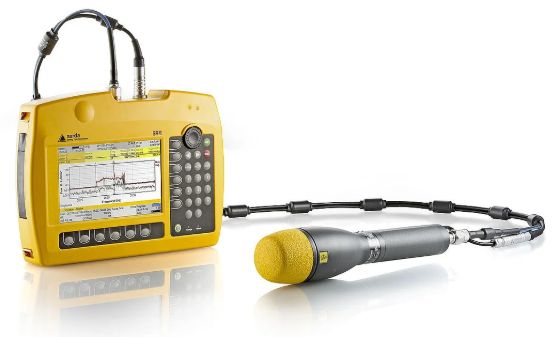
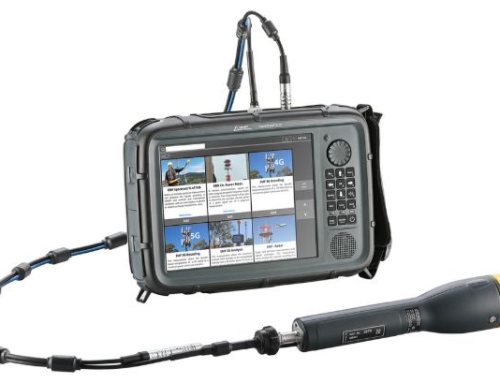
SRM-3006 basic unit with triaxial (isotropic) E-field antenna.

7-inch colour display and keypad; housing designed for harsh field conditions.
SRM-3006, SignalShark EMF or FieldMan?
The three instruments answer the same question at different depths. The table below helps the choice.
| Feature | SRM-3006 | SignalShark EMF | FieldMan |
|---|---|---|---|
| Measurement type | Frequency-selective | Frequency-selective, real-time | Broadband |
| Frequency range | 9 kHz – 6 GHz | 8 kHz – 8 GHz | 0 Hz – 90 GHz (depending on probe) |
| 5G FR2 (24.25 – 29.5 GHz) | With optional antenna | With optional antenna | With suitable probe |
| Service and operator separation | Yes | Yes | No (total field) |
| 5G / LTE extrapolation | LTE and 5G NR options | Traffic and code-selective, 5G Analyzer | No |
| Real-time bandwidth | — | 40 MHz | — |
| Display | 7-inch | 10.4-inch touchscreen | 5-inch |
| Weight | 2.8 kg | approx. 4.1 kg | 695 g (without probe) |
| Typical use | Base station and transmitter compliance | Advanced analysis, 5G, long-term monitoring | Fast survey, wide frequency, workplace safety |
Details: NARDA SignalShark EMF · NARDA FieldMan · all NARDA EMF measuring instruments.
Key features
The information below is compiled from NARDA’s product page and datasheet.
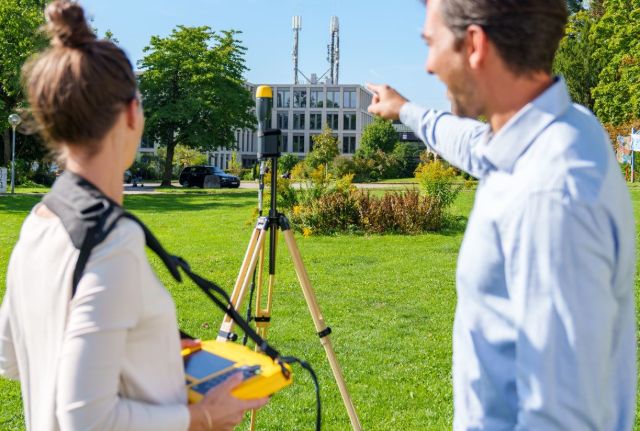
Easy to use, detailed analysis
As simple as a broadband meter
It is as easy to use as a broadband meter, yet contains a powerful spectrum analyzer. Results are shown as field strength (V/m, A/m), power density (W/m²) or percentage of the limit value.

Standard-compliant evaluation
ICNIRP and national regulations
Results are evaluated on the instrument according to ICNIRP and national or international standards and shown as a percentage of the permissible limit. No spreadsheets needed, less risk of error.
An antenna for every requirement
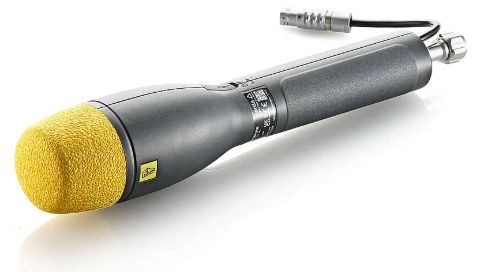
E and H fields, long wave to 5G
Antennas are available for electric and magnetic fields, from long wave to the latest mobile communication bands.

Quick measurement without alignment
Isotropic (triaxial) antennas
Concentric X, Y and Z sensors in the isotropic antennas measure the field independently of direction; the SRM-3006 calculates the resulting field strength automatically. There is no need to point the antenna at the source.

Time-saving routines
Programmable measurement sequences
Programmable routines, stored setups and automatic settings prepare recurring measurements in advance. Results become reproducible and the risk of wrong settings drops.

Precise safety assessment
Operator-by-operator separation
Frequency-selective measurement records the mobile channels of different operators separately. Worst-case evaluations are also possible by decoding the signal structures.
Handy and fit for the field
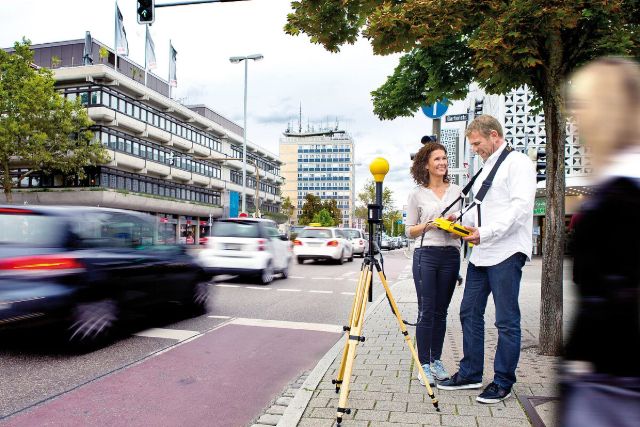
200 V/m immunity, splash-proof
Immune to fields up to 200 V/m, rugged and splash-proof. Replaceable batteries, GPS and voice recorder simplify work on site; it performs just as well in the laboratory.

5G code-selective measurement
5G NR option, FR1
With the 5G NR option, 5G signals in FR1 are measured code-selectively, at any time and without the operator being on site.
5G FR2 antenna
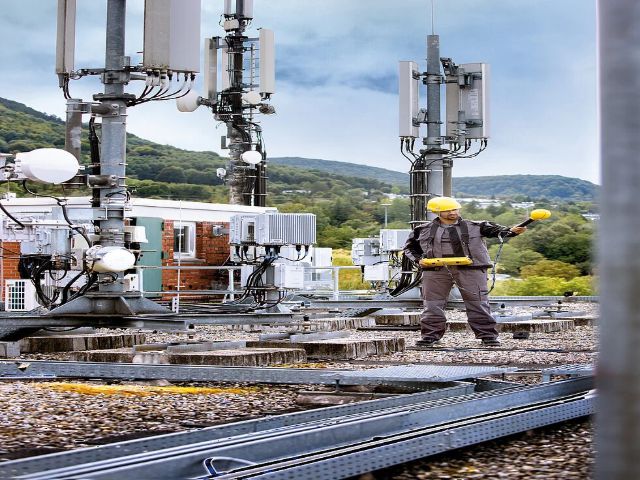
24.25 – 29.5 GHz
The E-field antenna extends the SRM-3006 to the FR2 band (millimetre wave) of 5G NR. Available as directional, omnidirectional or both.
Operating modes
Three modes are standard; the others are added as options when needed.
Safety Evaluation
Standard
Exposure contributions and total for definable frequency ranges, services and operators, as absolute values or as a percentage of current personal protection standards. A table view makes services easy to assign.
Spectrum Analysis
Standard
Detailed field analysis in the frequency domain with all the options of a high-performance spectrum analyzer.
Level Recorder
Standard
Fast, direct display of a signal’s time history on an adjustable fixed frequency with bandwidths up to 32 MHz.
5G NR
Option 3701/08
Code-selective EMF measurement of 5G signals in FR1.
LTE-FDD
Option 3701/06
Measurement of cell-specific signals of LTE cells in FDD networks and extrapolation to maximum field strength at full load.
LTE-TDD
Option 3701/07
The same measurement and full-load extrapolation for LTE cells in TDD networks.
UMTS P-CPICH
Option 3701/04
Selective detection of the field contributions of individual radio cells and extrapolation to maximum field strength at full load.
Scope
Option 3701/05
Real-time graphic display of pulsed signals over time, similar to an oscilloscope, with resolutions from microseconds to 24 hours.
Measuring antennas
Antennas are chosen by field type (E or H) and frequency. Values are from the NARDA datasheet; uncertainty is expanded (k = 2).
| Antenna (part no.) | Type and frequency | Dynamic range | Use |
|---|---|---|---|
| 3501/03 | Triaxial E-field, 27 MHz – 3 GHz | 0.2 mV/m – 200 V/m | Broadcast and mobile, direction-independent |
| 3502/02 | Triaxial E-field, 200 MHz – 6 GHz | 0.14 mV/m – 160 V/m | Latest mobile and wireless technologies |
| 3581/02 | Triaxial H-field, 9 kHz – 250 MHz | 2.5 µA/m – 560 mA/m | Near field at radio / TV transmitters and industry |
| 3531/01 | Single-axis E-field, 27 MHz – 3 GHz | 60 µV/m – 80 V/m | Precision measurement in mobile communications |
| 3531/04 | Single-axis active E-field, 9 kHz – 300 MHz | 50 µV/m – 36 V/m | Near field at transmitters and industry |
| 3551/02 | Single-axis active H-field, 9 kHz – 300 MHz | 0.4 µA/m – 71 A/m | Near field at transmitters and industry |
| 3591/101, /102, /103 | 5G FR2 E-field, 24.25 – 29.5 GHz | Separate datasheet | Directional, omnidirectional or both |
Single-axis antennas do not have to scan their axes in sequence, so they measure faster; this is an advantage with pulsed signals and also gives higher sensitivity.
Applications
The measurement environments where the SRM-3006 is used most.
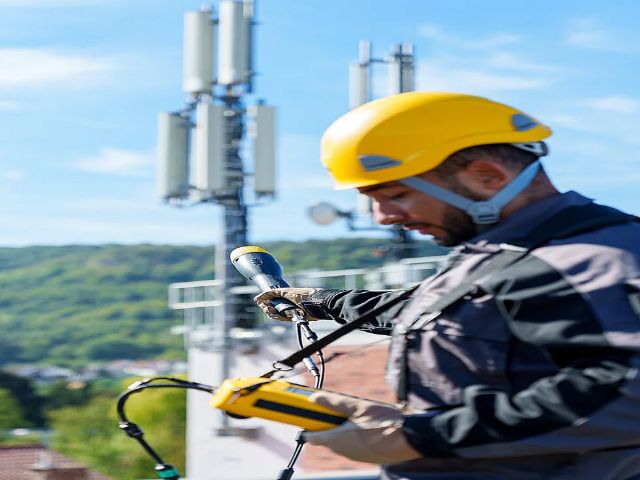
Base stations and rooftop sites
Where several operators share a rooftop, the contribution of each operator and each technology is measured separately; full-load extrapolation is applied for LTE and 5G.

Radio and TV transmitters
Near-field measurement at transmitters from long and medium wave up to VHF with H-field and active single-axis antennas.
Environmental and complaint measurements
Around schools, hospitals and homes the report shows which source contributes how much; the result is compared directly with the limits in the applicable regulations.
Specifications
| Feature | Value |
|---|---|
| Frequency range | 9 kHz – 6 GHz (basic unit) · 24.25 – 29.5 GHz with the 5G FR2 antenna |
| Resolution bandwidth (RBW) | Spectrum Analysis: 10 Hz – 20 MHz · Level Recorder / Scope: 100 Hz – 32 MHz · UMTS: fixed 3.84 MHz |
| Measurement range | −30 … +20 dBm; 0 – 50 dB RF input attenuation, adjustable in 1 dB steps |
| Noise level (DANL) | ≤ 30 MHz: < −160 dBm/Hz · ≤ 2 GHz: < −156 dBm/Hz · ≤ 6 GHz: < −150 dBm/Hz |
| Level uncertainty | ≤ 1.2 dB (15 – 30 °C) |
| System uncertainty (IEC 62232) | With antenna 3502/02: 1.89 – 2.13 dB · with 3501/03: 2.31 – 2.64 dB |
| RF immunity | 200 V/m |
| Display | 7-inch colour TFT-LCD, 800 × 480, indoor and outdoor |
| Memory | 128 MB (up to 8,000 spectra or 4,000 screenshots); time-controlled logging up to 99 hours |
| Battery | Li-ion 7.2 V / 6200 mAh, replaceable; approx. 2.5 hours operation |
| External power | 9 – 15 V DC; 100 – 240 V AC adapter |
| Interfaces | N-type RF input (50 Ω), USB 2.0 mini B, optical RS-232, 3.5 mm earphone |
| Other | Built-in GPS, voice recorder |
| Protection class | IP52 (antenna attached, interface protector closed) |
| Operating temperature | −10 … +50 °C (on battery) · 0 … +40 °C (external supply) |
| Size and weight | 213 × 297 × 77 mm · 2.8 kg (with battery) |
Sets, options and software
| Part no. | Contents |
|---|---|
| 3006/202 | Set 2: basic unit (no antenna), 1.5 m cable, trolley hardcase |
| 3006/208 | Set 8: basic unit + 3501/03 triaxial E-field antenna (27 MHz – 3 GHz) |
| 3006/209 | Set 9: basic unit + 3502/02 triaxial E-field antenna (200 MHz – 6 GHz) |
| 3006/210 | Set 10: basic unit + 3502/02 + 3581/02 H-field antenna (9 kHz – 250 MHz) |
| 3701/04 · 05 · 06 · 07 · 08 | UMTS P-CPICH · Scope · LTE FDD · LTE TDD · 5G NR options |
| 3591/101 · 102 · 103 | 5G FR2 antenna sets: directional · omnidirectional · both |
| 3006/93.10 | SRM-3006 TS: PC evaluation and remote control software |
| — | SRM-3006 Tools configuration software (free) |
| 3602/02 · 3001/90.15 | 5 m RF cable · spare battery |
EMF measurement: a short guide
Broadband or frequency-selective?
A broadband meter gives the sum of all sources as one number; ideal for a quick survey. A frequency-selective meter splits that sum into transmitters and services; if the limit is exceeded it shows the source responsible, if not it shows the remaining margin.
Isotropic measurement
A triaxial antenna measures the X, Y and Z components of the field and calculates the resultant. The measurement becomes independent of the direction the antenna faces and is reproducible.
Percentage of the limit
Each service’s contribution is expressed as a percentage of the limit at its own frequency, and these percentages are added up. If the total is below 100 %, the measuring point is compliant. This reduces sources at different frequencies to one criterion.
Full-load extrapolation
In LTE and 5G the transmit power varies with traffic. The value at the time of measurement does not show the worst case; decoding the control channels gives the maximum field strength at full load.
Measurement uncertainty
The reliability of the reported value depends on measurement uncertainty. The SRM-3006 datasheet gives the combined uncertainty of antenna and basic unit, so no separate calculation is needed.
Which limits apply?
In Turkey the current regulations of the BTK apply, and in workplaces the relevant occupational health and safety regulations. The instrument can evaluate according to different standards, including ICNIRP.
Common situations in measurement
| Situation | Possible cause | What to do with the SRM-3006 |
|---|---|---|
| A broadband meter shows a value close to the limit | Several sources overlapping | Separate the contributions service by service with Safety Evaluation |
| Value is low at the time of measurement, but complaints continue | Traffic-dependent power (LTE, 5G) | Use the LTE / 5G NR options for full-load extrapolation |
| Results change with direction | Single-axis antenna or reflections | Measure with an isotropic antenna and repeat at several points |
| Radar or pulsed source | Short high peak values | Examine over time with Scope mode and a single-axis antenna |
| Low frequency near a transmitter | Near field, H-field dominant | Use the 3581/02 H-field or 3551/02 active antenna |
Frequently asked questions
What is the NARDA SRM-3006?
A frequency-selective EMF measuring instrument that measures electromagnetic fields separately by frequency band, service and operator. It covers 9 kHz – 6 GHz and up to 29.5 GHz with the 5G FR2 antenna.
How does it differ from a broadband EMF meter?
A broadband meter only gives the total field strength. The SRM-3006 shows which transmitter the total comes from and calculates each source’s share of the limit. The FieldMan is used for fast surveys, the SRM-3006 for detailed, reportable analysis.
Can it measure 5G?
Yes. In FR1 the 5G NR option performs code-selective measurement; FR2 (24.25 – 29.5 GHz) requires the separate 5G FR2 antenna.
Which standards are results evaluated against?
ICNIRP and national or international standards; the result is shown directly as a percentage of the limit. In Turkey the BTK regulations apply.
Which set should I choose?
For mobile communication measurements the most common choice is Set 9 with the 3502/02 antenna. If broadcast transmitters and industrial sites are also to be measured, Set 10 with the H-field antenna is chosen.
How does it differ from the SignalShark EMF?
The SignalShark EMF is a new-generation real-time (40 MHz) EMF analyzer: it measures up to 8 GHz and has a 10.4-inch touchscreen and 5G Analyzer options. All SRM-3006 antennas can also be used with the SignalShark EMF.
Is there a Turkish user manual?
Yes, a Turkish user manual is in the documents section below.
How are calibration and service handled?
PROTEL is the general distributor of Narda Safety Test Solutions for Turkey. Just write to us for calibration and service.
Why PROTEL?
| Topic | How |
|---|---|
| Distribution | General distributor of Narda Safety Test Solutions for Turkey |
| Experience | We have sold the SRM-3006 in Turkey for many years and support its users |
| Product selection | We work out the right combination of set, antennas and options for the sources you will measure |
| Language | Turkish product information, Turkish user manual, quotations and technical communication |
| Calibration, service, training | Engineering, service, calibration and training |
| Sales territory | Turkey for NARDA products |
Get a quote for the NARDA SRM-3006
To speed up your quote, just tell us:
- What you will measure — base station, broadcast transmitter, radar, industrial site
- Frequency range and whether 5G FR2 is needed
- Options — 5G NR, LTE FDD / TDD, UMTS, Scope
- Set — Set 8, 9 or 10; additional antennas
- Quantity; whether training is needed
Email: [email protected] · Phone: +90 212 221 80 60 · WhatsApp: +90 532 265 91 99
Documents
Related pages
- Occupational safety EMF measurement sets for İSGÜM / TÜRKAK laboratories (TS EN 50413)
- NARDA SignalShark EMF: real-time frequency-selective EMF analyzer
- NARDA FieldMan EMF meter
- Electromagnetic field (EMF) measuring instruments
- NARDA EMF monitors
- NARDA SignalShark interference and direction finding analyzer
- NARDA products
Product images and technical information on this page © Narda Safety Test Solutions GmbH; used with the manufacturer’s permission. Technical values are taken from the manufacturer’s datasheet; the current datasheet is binding. Source: narda-sts.com