NARDA Safety Test Solutions · For occupational hygiene measurement laboratories
NARDA Instruments for Occupational Safety EMF Measurements: TS EN 50413 Sets for İSGÜM and TÜRKAK Laboratories
NARDA instrument sets for laboratories that perform, or are preparing to perform, electromagnetic field (EMF) exposure measurements under İSGÜM authorisation and TÜRKAK accreditation in Turkey. This page answers specifications that ask for low-frequency (1 Hz – 400 kHz) electric and magnetic field, high-frequency (100 kHz – 90 GHz) electric field, three-axis (isotropic) measurement, data logging and time averaging point by point: which probe measures what, which frequency range each set covers, and up to which frequency the calibration is accredited, based on the manufacturer’s datasheets.
- TS EN 50413 and TS EN 50413/A1
- LF E and H: 1 Hz – 400 kHz
- RF E: 100 kHz – 90 GHz
- Three-axis isotropic probes
- Logging, 6 min and 30 min averaging
- Directive 2013/35/EU weighted peak
- DAkkS accredited calibration
- 5 ready-to-quote sets
PROTEL is the general distributor of NARDA Safety Test Solutions for Turkey. Our sales authority for NARDA products is limited to Turkey. Instrument selection, quotation, delivery, calibration and training are handled from Istanbul.
Who is this page for and which request does it answer?
We are receiving quotation requests with the same structure from occupational hygiene laboratories: an EMF measuring instrument and probes for İSGÜM and TÜRKAK electromagnetic field measurement under TS EN 50413, suitable for low-frequency (1 Hz – 400 kHz) and high-frequency (100 kHz – 90 GHz) measurement, three-axis, with data logging or averaging.
No single instrument or single probe meets this request. The right solution is one base unit, an analyzer that measures electric and magnetic fields together at low frequencies, and two complementary electric field probes for high frequencies. Below we explain this step by step, recommend five sets with NARDA’s current products and show in a table which coverage each set provides.
Our aim is that your laboratory builds the measurement range it will declare for İSGÜM authorisation and TÜRKAK accreditation with the right instruments from the start. A wrong probe choice can leave a frequency gap that is expensive to close later, or a range that cannot be written into the accreditation scope.
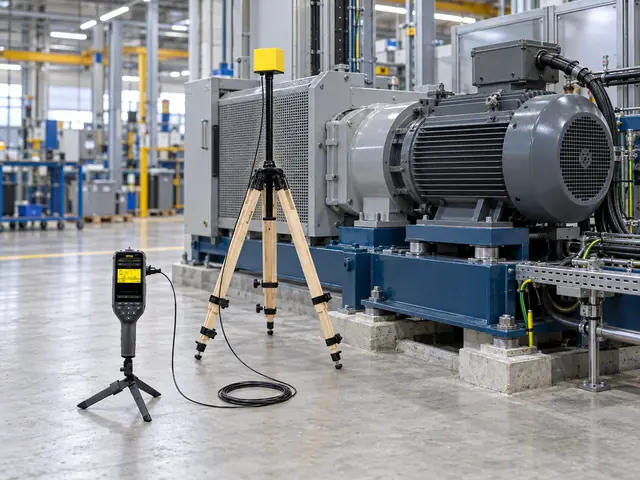
Occupational safety EMF measurement in a factory: NARDA EHP-50F on a tripod next to an electric motor, connected to the FieldMan by fiber-optic cable.
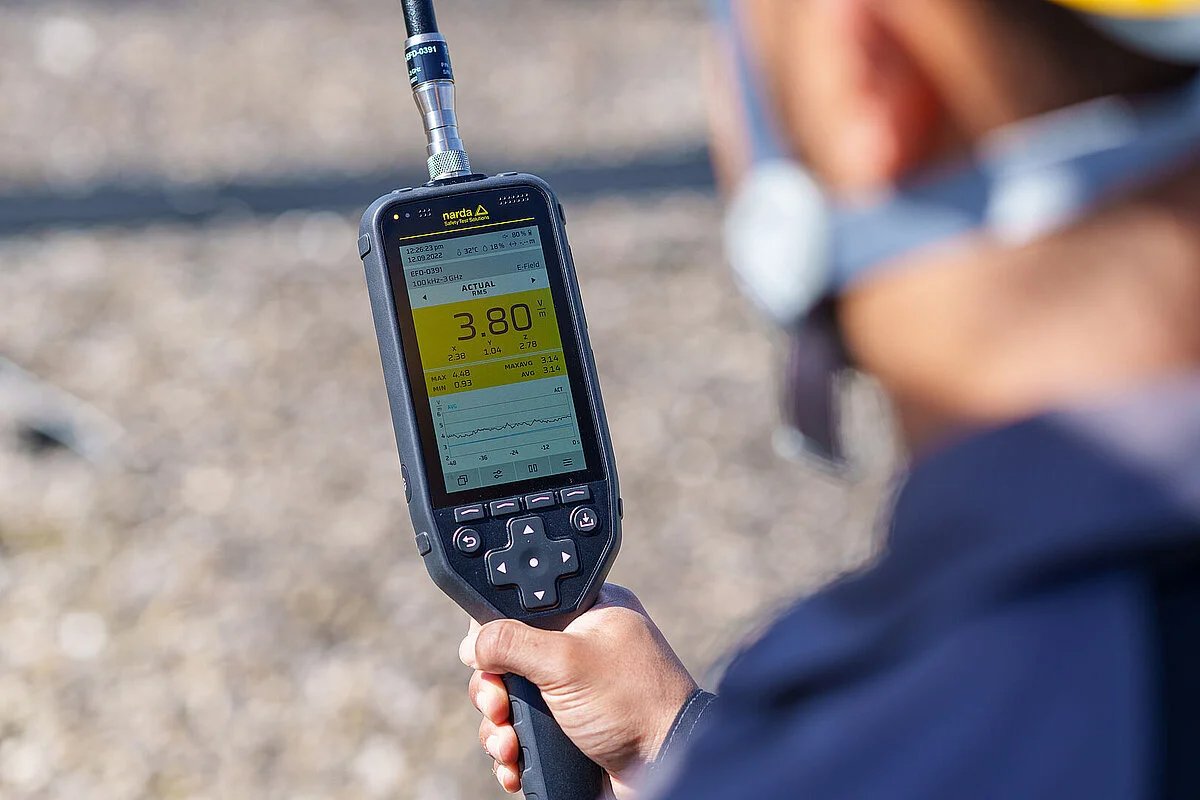
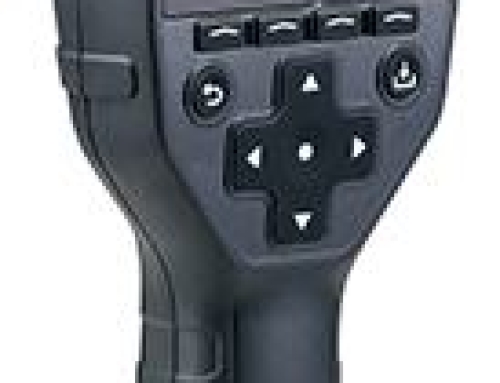
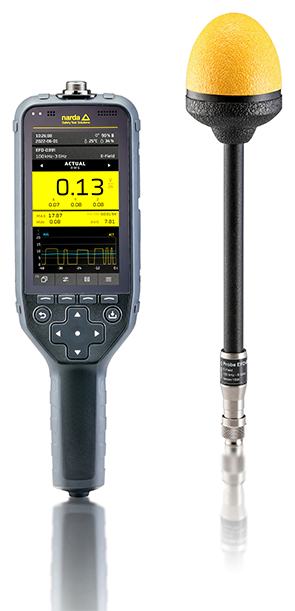
FieldMan: one base unit, interchangeable digital probes.
TS EN 50413, the A1 amendment, İSGÜM and TÜRKAK: what you need to know
The information below is taken from the TSE standards catalogue, İSGÜM’s laboratory authorisation page and its sample method list (November 2026).
| Topic | Current status |
|---|---|
| TS EN 50413 (Turkish text) | Accepted by TSE on 16.12.2019, Turkish translation dated 08.03.2023; in force. Equivalent to EN 50413:2019. Basic standard on measurement and calculation procedures for human exposure to electric, magnetic and electromagnetic fields, 0 Hz – 300 GHz. |
| TS EN 50413/A1 | Accepted by TSE on 22.12.2025; English text, 12 pages; in force. Equivalent to EN 50413:2019/A1:2025 and amends TS EN 50413:2019. There is no consolidated Turkish edition yet: the amendment is applied together with the 2019 standard. |
| What A1 changes | Subclause 5.2.2.5 (assessment methods) now states that signal modulation and duty cycle can affect the measurement or calculation and must be considered when checking limits. A new informative Annex B explains radio transmission modulation: ITU emission classes and the relationship between carrier, mean and peak power. At European level the date of publication (dop) is 30.11.2026 and the date of withdrawal of conflicting standards (dow) is 30.11.2028. |
| İSGÜM sample method list | For the parameter “Electromagnetic field exposure measurement”, the method is listed as TS EN 50413 (16.12.2019). |
| İSGÜM electromagnetic field announcement (2018) | Laboratories are authorised for the EMF exposure parameter according to the measurement ranges of their instruments, and the TÜRKAK accreditation certificate must cover the same range. |
| Authorisation file | TÜRKAK accreditation certificate and scope, instrument list, calibration plan with internationally traceable calibrations, measurement uncertainty calculations, method validation or verification, Turkish test instructions, and proficiency testing or interlaboratory comparison at least once every four years per parameter. |
What does this mean for instrument selection?
- Your instruments define your measurement range. Because İSGÜM authorises according to the range of your instruments and TÜRKAK’s scope must cover the same range, you need a calibrated probe set that can measure the range you want to declare.
- The A1 amendment draws attention to modulated signals. For sources such as 5G TDD, Wi-Fi or pulsed radar, a frequency-selective analyzer that shows the signal structure (SRM-3006 or SignalShark EMF) strengthens the assessment alongside broadband measurement.
- Update your method documents. It is sensible for your test instructions to refer to TS EN 50413/A1 as well as TS EN 50413 and to describe how you handle modulation and duty cycle. You decide the scope and method according to the TÜRKAK and İSGÜM processes; we help you set up the instrument side correctly.
Required features and how NARDA meets them
The requirements that appear most often in quotation requests and the NARDA product that meets each (according to NARDA datasheets):
| Requirement | NARDA solution | Note |
|---|---|---|
| Low frequency 1 Hz – 400 kHz, electric and magnetic field | EHP-50F: measures E and H fields simultaneously on three axes, 1 Hz – 400 kHz; FFT analysis | BFD-400-1/-3 measure only the magnetic field; they do not replace EHP-50F for the LF electric field. |
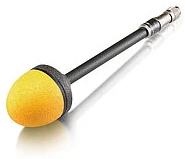
| High frequency 100 kHz – 90 GHz, electric field | Two probes: EFD-0391 (100 kHz – 3 GHz) + EFD-9091 (100 MHz – 90 GHz) — Set E | No single probe covers 100 kHz – 90 GHz. EFD-9091 starts at 100 MHz, not 100 kHz. |
| Three-axis (isotropic) measurement | All FieldMan E and H probes and EHP-50F are tri-axial isotropic | The isotropic total (RSS) is shown; EHP-50F provides X, Y, Z results separately in the PC software. If you need separate axis records for RF probes, tell us before ordering. |
| Data logging | FieldMan timer logging: up to 100 h, 1 s – 6 min intervals, up to 32,000 intervals; EHP-50F standalone logger: up to 36 h at 30 s or 60 s intervals | The FieldMan RF or LF Basic Sets need the Data Storage option (2460/95.15) to store data on the unit. |
| Averaging | FieldMan time averaging 1 s – 24 h, including 6 min and 30 min; spatial averaging over up to 100 positions; Avg and Max Avg results | 6-minute averaging is the usual reference for RF exposure; check the averaging time required by the limit set you use. |
| Assessment against Directive 2013/35/EU | EHP-50F Weighted Peak: ICNIRP 1998/2010 and 2013/35/EU (limbs, low and high action levels); BFD-400-1: 2013/35/EU LAL, HAL, limbs | Weighted peak is the time-domain method for non-sinusoidal LF fields (IEC 61786-2, IEC/EN 62311). |
| Calibration | Factory calibration or DAkkS accredited calibration (ILAC-MRA), recommended interval 24 months; FieldMan base unit needs no calibration | All probes can also be ordered with accredited calibration (included as standard for some probes, at extra cost for others). NARDA performs accredited calibration up to 18 GHz in its own DAkkS laboratory; for EFD-9091, EFD-6091 and EFD-4091, if accredited calibration above 18 GHz is required, the probe is calibrated at an external accredited laboratory before delivery. |
Six critical points before quoting
The mistakes we see most often when reviewing specifications, and how to avoid them:
1. The 400 kHz – 100 MHz gap
FieldMan + EHP-50F + EFD-9091 leaves a gap
EHP-50F ends at 400 kHz and EFD-9091 starts at 100 MHz. Without a second RF probe starting at 100 kHz (EFD-0891, EFD-0691 or EFD-0391), the 400 kHz – 100 MHz band — industrial RF heating, RF welding, broadcast — is not measured.
2. Accredited calibration above 18 GHz: specify it in the order
EFD-9091: NARDA up to 18 GHz, external accredited lab above
EFD-9091 measures up to 90 GHz. NARDA calibrates it with accreditation up to 18 GHz in its own laboratory; if accredited calibration is also required for 18 – 90 GHz, the probe is sent to an external accredited laboratory before delivery and supplied with that certificate. If you plan to declare up to 90 GHz in your accreditation scope, this must be specified in the order.
3. BFD-400 does not replace EHP-50F
Magnetic only vs. electric and magnetic
BFD-400-1/-3 measure the magnetic field from 1 Hz to 400 kHz and plug straight into FieldMan. If the specification asks for the LF electric field as well, EHP-50F is required.
4. Logging needs the right configuration
Data Storage option
The FieldMan Basic Set includes RF, LF and data storage. If an RF or LF Basic Set is chosen, add the Data Storage option; otherwise results cannot be stored on the unit.
5. Three-axis ≠ separate axis records
Isotropic total (RSS)
All probes measure on three axes and report the isotropic total. EHP-50F gives X, Y, Z separately in the PC software. If you need per-axis records for RF, tell us so we can check it with NARDA before the order.
6. A1 and modulated signals
Frequency-selective support
TS EN 50413/A1 asks for modulation and duty cycle to be considered. For 5G, Wi-Fi or radar sources, the frequency-selective SRM-3006 or SignalShark EMF shows which service contributes how much to the total.
Recommended instrument sets
The sets are ordered from A to E by increasing frequency coverage and increasing cost. Every set includes the FieldMan Basic Set (RF, LF, data storage), EHP-50F and a non-conductive tripod; the sets differ in the RF probe. All probes can be ordered with factory calibration or with accredited calibration. The sets are PROTEL’s technical recommendations, not NARDA package names; order codes, current versions and package contents are confirmed with NARDA at the quotation stage.
Set A — up to 3 GHz
LF 1 Hz – 400 kHz (E, H) · RF 100 kHz – 3 GHz (E)
- FieldMan Basic Set (RF, LF, data storage)
- EHP-50F electric and magnetic field analyzer
- EFD-0391, 100 kHz – 3 GHz
- Non-conductive tripod
The most economical start: power frequency, induction, RF heating and welding, broadcast transmitters, and mobile and Wi-Fi (2.4 GHz) sources up to 3 GHz.
Set B — up to 6 GHz
LF 1 Hz – 400 kHz (E, H) · RF 100 kHz – 6 GHz (E)
- FieldMan Basic Set (RF, LF, data storage)
- EHP-50F electric and magnetic field analyzer
- EFD-0691, 100 kHz – 6 GHz
- Non-conductive tripod
All sources up to 6 GHz with one probe, including 5G FR1 (3.5 GHz) and 5 GHz Wi-Fi.
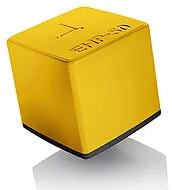
Set C — up to 8 GHz
LF 1 Hz – 400 kHz (E, H) · RF 100 kHz – 8 GHz (E)
- FieldMan Basic Set (RF, LF, data storage)
- EHP-50F electric and magnetic field analyzer
- EFD-0891, 100 kHz – 8 GHz
- Non-conductive tripod
All everyday workplace sources up to 8 GHz with one probe, including Wi-Fi 6E/7 (6 GHz band).
Set D — up to 18 GHz
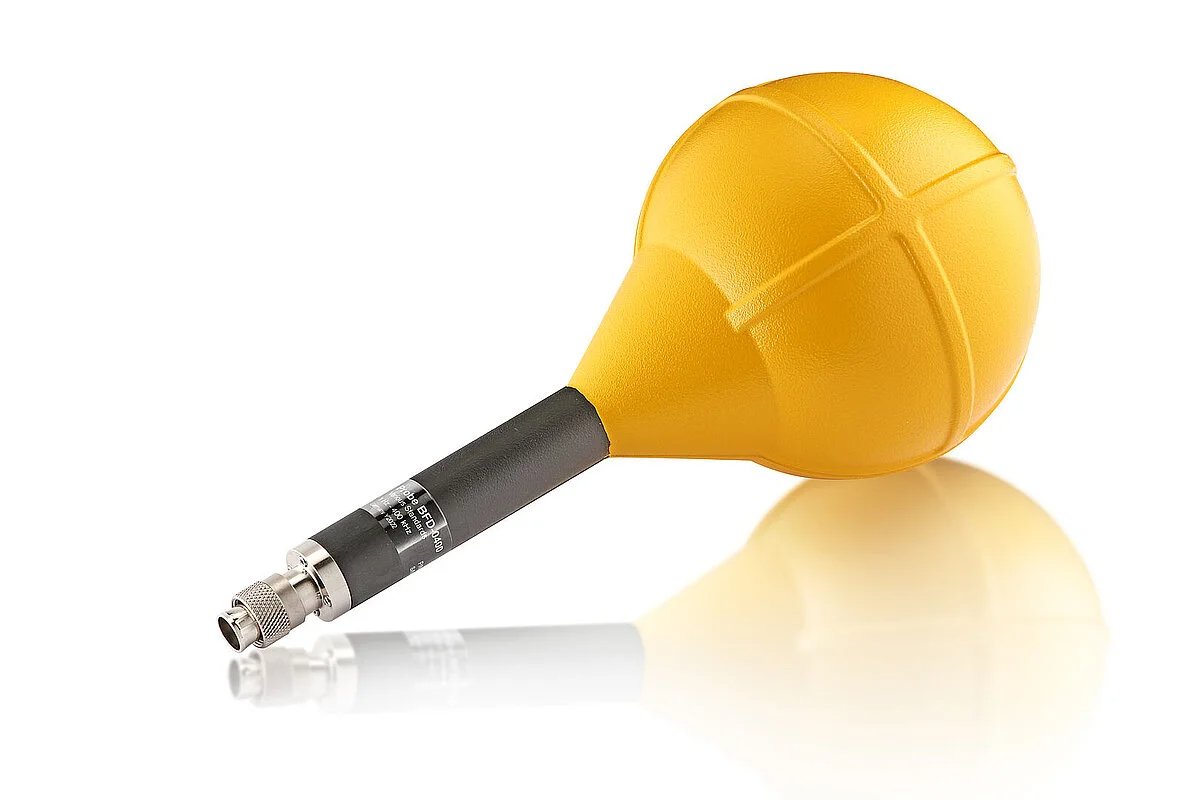
LF 1 Hz – 400 kHz (E, H) · RF 100 kHz – 18 GHz (E)
- FieldMan Basic Set (RF, LF, data storage)
- EHP-50F electric and magnetic field analyzer
- EFD-0391, 100 kHz – 3 GHz
- EFD-1891, 2 MHz – 18 GHz
- Non-conductive tripod
Includes radar, satellite ground stations and microwave links up to 18 GHz. According to its datasheet, EFD-1891’s accredited calibration covers its whole range.
Set E — up to 90 GHz
LF 1 Hz – 400 kHz (E, H) · RF 100 kHz – 90 GHz (E)
- FieldMan Basic Set (RF, LF, data storage)
- EHP-50F electric and magnetic field analyzer
- EFD-0391, 100 kHz – 3 GHz
- EFD-9091, 100 MHz – 90 GHz
- Non-conductive tripod
The full specification: 1 Hz – 90 GHz. Because EFD-9091 starts at 100 MHz, the 100 kHz – 100 MHz range is measured with EFD-0391. Accredited calibration by NARDA up to 18 GHz; above 18 GHz, on request, at an external accredited laboratory.

Add-ons
Magnetic field and frequency-selective measurement
- BFD-400-1/-3: LF magnetic field on the FieldMan display, 2013/35/EU weighted peak
- HFD-3061 (300 kHz – 30 MHz) and HFD-0191 (27 MHz – 1 GHz): RF magnetic field in the near field
- SRM-3006 (9 kHz – 6 GHz) or SignalShark EMF (8 kHz – 8 GHz): share per service, modulation assessment
- EHP-200A: selective E and H, 9 kHz – 30 MHz
Set comparison
| Set | RF electric field probe | RF coverage | Best for |
|---|---|---|---|
| Set A | EFD-0391 | 100 kHz – 3 GHz | Industrial sources and telecom up to 3 GHz |
| Set B | EFD-0691 | 100 kHz – 6 GHz | Including 5G FR1 and 5 GHz Wi-Fi |
| Set C | EFD-0891 | 100 kHz – 8 GHz | Including Wi-Fi 6E/7, one probe |
| Set D | EFD-0391 + EFD-1891 | 100 kHz – 18 GHz | Radar, satellite and links up to 18 GHz |
| Set E | EFD-0391 + EFD-9091 | 100 kHz – 90 GHz | The full specification up to 90 GHz |
The low-frequency coverage is the same in every set: 1 Hz – 400 kHz electric and magnetic field with EHP-50F. All probes can be ordered with accredited calibration as well as factory calibration; for some probes accredited calibration is included in the price as standard, for others it is available at extra cost. NARDA performs accredited calibration up to 18 GHz in its own laboratory; for higher frequencies, if accredited calibration is required, the probe is calibrated at an external accredited laboratory before delivery. We state the calibration type and scope for each probe in writing in the quotation. Recommended calibration interval 24 months.
Technical guide: NARDA EMF measuring instruments for İSGÜM and TÜRKAK (PDF)
We have prepared the detailed version of this page as a 10-page technical guide that you can share with your laboratory team. It includes diagrams and comparison tables:
- TS EN 50413 and TS EN 50413/A1 timeline and what A1 changes
- Decision flow: which NARDA component for which requirement
- Frequency coverage chart of all FieldMan probes, with the 400 kHz – 100 MHz gap
- Sets A–E, alternative configurations and accredited calibration coverage
- EHP-50F FFT windows, near-field E and H, three-axis, logging and averaging
- TÜRKAK R10.12 traceability, checklist before requesting a quote, FAQ and sources
Probe and instrument selection by frequency band
Typical workplace sources and the suitable NARDA solution for each band:
| Frequency band | Typical workplace sources | NARDA solution |
|---|---|---|
| 1 Hz – 400 kHz | Transformers, switchgear and busbars, welding machines, induction furnaces and hardening, electric motors and drives | E and H: EHP-50F. H only: BFD-400-1/-3 |
| 100 kHz – 30 MHz | Induction heating, RF plastic welding and sealing (13.56 / 27.12 MHz), MF/HF transmitters | E: EFD-0891 or EFD-0391. H: HFD-3061. Selective: EHP-200A |
| 30 MHz – 1 GHz | FM and TV transmitters, PMR/TETRA radios, RF drying and heating | E: EFD-0891. H: HFD-0191. Selective: SRM-3006, SignalShark EMF |
| 1 – 8 GHz | Mobile base stations (4G, 5G FR1), Wi-Fi 6/6E/7, industrial microwave (2.45 GHz), radar and links | E: EFD-0891. Selective: SRM-3006 (up to 6 GHz), SignalShark EMF (up to 8 GHz) |
| 8 – 90 GHz | Radar, satellite ground stations, microwave links, 5G FR2 | E: EFD-9091 (up to 90 GHz), EFD-1891 (up to 18 GHz), EFD-4091 (up to 40 GHz) |
Measurement, logging and averaging: FieldMan and EHP-50F
FieldMan is the base unit that works at low and high frequencies on the same display by changing probes. The probes are digital and carry their own calibration data, so the base unit is not calibrated separately.
- Result types: actual, maximum, minimum, average (Avg) and maximum average (Max Avg).
- Time averaging: 1 s, 3 s, 10 s, 30 s, 1 min, 3 min, 6 min, 10 min, 30 min, 1 h, 6 h and 24 h.
- Spatial averaging: bar graph and average line for up to 100 measurement positions.
- Timer logging: automatic wake-up and shutdown, up to 100 h, 1 s – 6 min intervals, up to 32,000 intervals; 750 MB internal memory, up to 128 GB with a memory card.
- Options: GPS and range finder, live measurement from a PC (Narda-TSX), remote reading up to 50 m with the fiber optic Repeater.
EHP-50F is a three-axis analyzer that measures electric and magnetic fields simultaneously. It connects to FieldMan by fiber optic cable, and also works with PC software or on its own. On its own it logs for up to 36 hours at 30 s or 60 s intervals. In Weighted Peak mode it gives the result as a percentage of the limit according to ICNIRP 1998/2010 and Directive 2013/35/EU (limbs, low and high action levels).
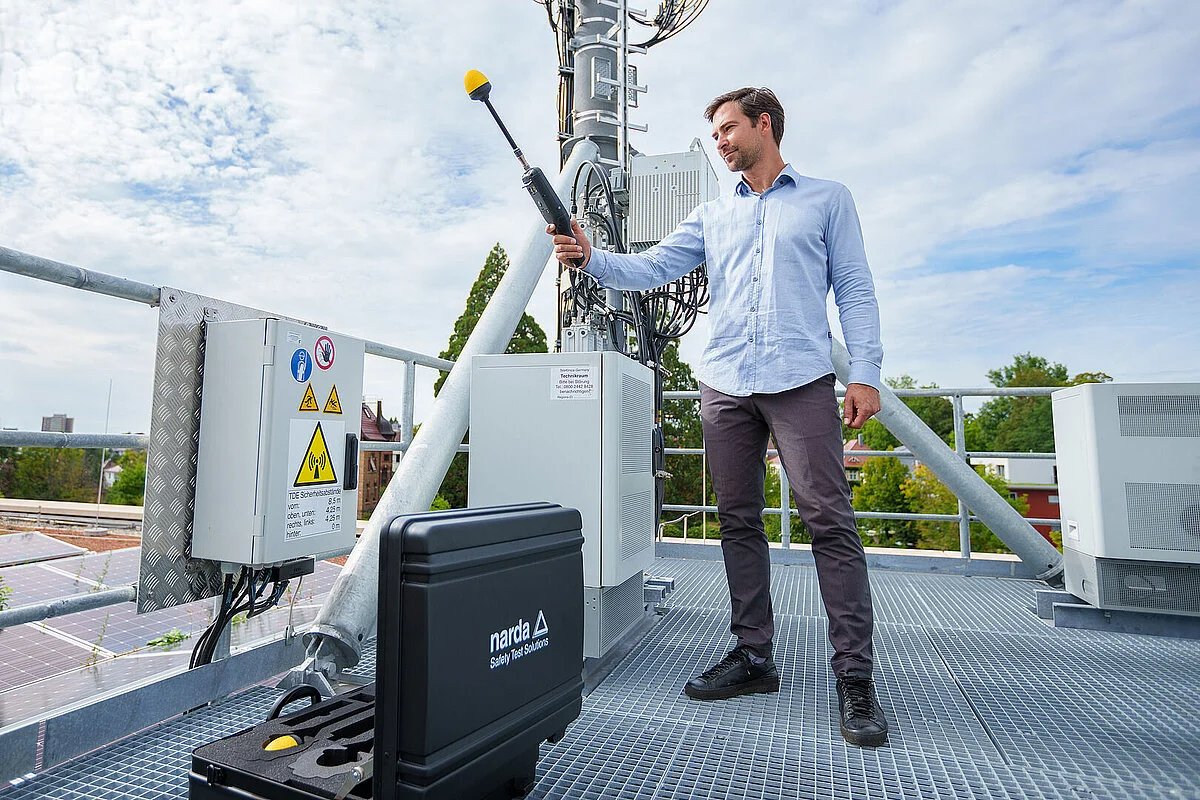
Spatial averaging and timer logging on a tripod.
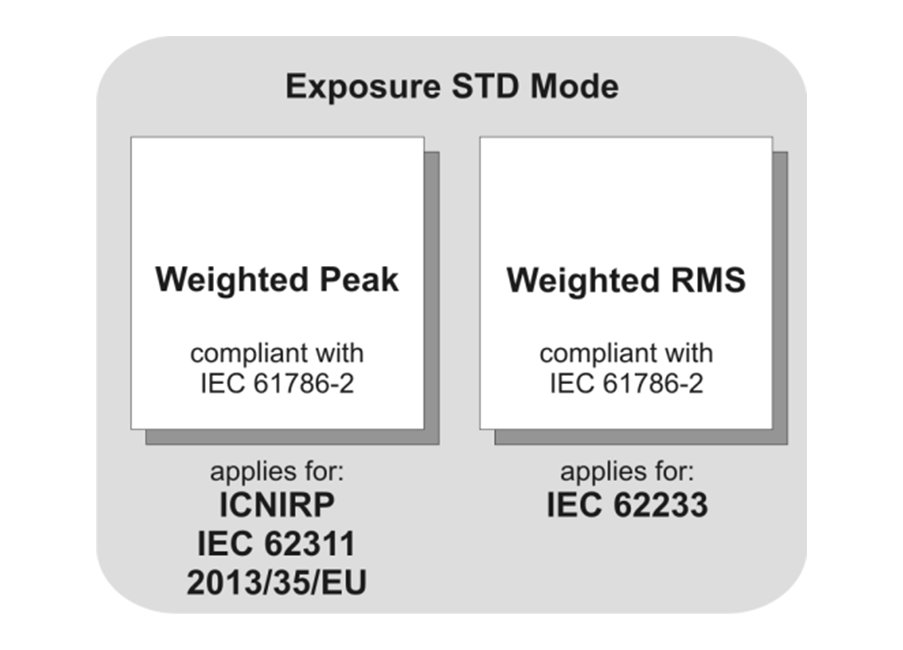
Exposure STD mode: Weighted Peak (ICNIRP, IEC 62311, 2013/35/EU) and Weighted RMS (IEC 62233).
Calibration and traceability
NARDA calibrates FieldMan RF probes under DAkkS accreditation (DIN EN ISO/IEC 17025, ILAC-MRA); the calibration data is stored in the probe and used automatically during measurement. The recommended calibration interval for the probes and EHP-50F is 24 months. EHP-50F can also be supplied with accredited calibration on request. İSGÜM requires calibrations from laboratories with international traceability; DAkkS is a signatory of the ILAC mutual recognition arrangement.
All NARDA probes can be ordered with factory calibration or with accredited calibration. For some probes accredited calibration is included in the price as standard; for others it is added at extra cost. We specify this for each probe in the quotation.
The point to watch is that the accredited scope does not cover the full measuring range of every probe: NARDA performs accredited calibration up to 18 GHz in its own DAkkS laboratory. For EFD-9091, EFD-6091 and EFD-4091, if accredited calibration above 18 GHz is required, NARDA sends the probe to an external accredited laboratory before delivery, has it calibrated there and delivers it with the certificate; otherwise a factory calibration applies above 18 GHz. For EFD-1891 the accreditation covers the whole range (2 MHz – 18 GHz). Before ordering, we obtain the calibration points, uncertainties and accredited scope for your chosen probes from NARDA in writing and pass them to you, so you can build your measurement uncertainty budget on these documents.
For periodic calibration, service and user training, contact us.
What to send us with your quotation request
- The frequency range you will declare for İSGÜM authorisation and TÜRKAK accreditation (e.g. 1 Hz – 400 kHz and 100 kHz – 18 GHz or 90 GHz)
- Field quantities: electric field only, or magnetic field as well at RF
- The workplaces and sources you will measure (power plants, steel, induction, RF welding, telecom, hospitals, etc.)
- Logging and averaging requirements, and whether separate X, Y, Z records are needed
- Whether you require accredited calibration over the whole declared range
- Instruments you already own (e.g. NBM-550 and NBM probes: existing NBM probes can be used on FieldMan with the A/D Probe Converter)
- Delivery address and invoicing details for the quotation
With this information we offer the right set, an alternative and the calibration documents in one quotation.
Frequently asked questions
Is TS EN 50413 still valid, and what is TS EN 50413/A1?
Yes. TS EN 50413 (16.12.2019, Turkish translation 08.03.2023) is in force. TSE accepted TS EN 50413/A1 on 22.12.2025 as an English text; it amends the 2019 standard and adds the consideration of modulation and duty cycle, together with a new informative Annex B. There is no consolidated Turkish edition yet.
Is 90 GHz mandatory for İSGÜM authorisation?
We found no general rule that every laboratory must go up to 90 GHz. According to İSGÜM, authorisation is given according to the range of your instruments, and the TÜRKAK certificate must cover that range. The upper frequency is therefore your decision; if your specification or target scope requires 90 GHz, Set E covers it.
Can one probe cover 100 kHz – 90 GHz?
No. EFD-9091 measures from 100 MHz to 90 GHz. A second probe starting at 100 kHz (EFD-0891, EFD-0691 or EFD-0391) is required for 100 kHz – 100 MHz.
Why EHP-50F rather than BFD-400 for low frequencies?
EHP-50F measures both the electric and the magnetic field from 1 Hz to 400 kHz. BFD-400-1/-3 measure only the magnetic field. If the specification asks for the LF electric field, EHP-50F is required; BFD-400 can be added for magnetic field measurement directly on the FieldMan display.
Is the calibration of EFD-9091 accredited up to 90 GHz?
Yes, on request. NARDA calibrates with accreditation up to 18 GHz in its own laboratory; if accredited calibration is required for 18 – 90 GHz, the probe is calibrated at an external accredited laboratory before delivery and supplied with the certificate. This must be specified in the order; otherwise a factory calibration applies above 18 GHz.
Does FieldMan perform 6-minute averaging and logging?
Yes. FieldMan offers time averaging from 1 s to 24 h, including 6 min and 30 min, spatial averaging over up to 100 positions, and timer logging for up to 100 hours. Logging on the RF or LF Basic Sets requires the Data Storage option.
Can we keep using our NBM-550 probes?
Existing NBM probes can be used on FieldMan with NARDA’s A/D Probe Converter. Their calibration status and accredited scope must be checked separately.
Do you also sell NARDA abroad?
No. Our sales authority for NARDA products is limited to Turkey. This page is intended for laboratories operating in Turkey under İSGÜM and TÜRKAK.
Why PROTEL?
| Topic | PROTEL |
|---|---|
| Distributor | General distributor of NARDA Safety Test Solutions for Turkey; working with NARDA since 2001 |
| Technical selection | We review your specification and target scope and propose the set without gaps |
| Calibration documents | Calibration points, uncertainties and accredited scope obtained from NARDA before ordering |
| Training and service | Turkish user training, periodic calibration and technical support from Istanbul |
| Sales area | Our NARDA sales authority is limited to Turkey |
Request a quote for an occupational safety EMF measurement set
Send us the frequency range you will declare and your specification; we will offer the suitable set from A – E and an alternative, together with the calibration documents.
E-mail: [email protected] · Phone: +90 212 221 80 60 · WhatsApp: +90 532 265 91 99
Related pages
- Technical guide: NARDA EMF measuring instruments for İSGÜM and TÜRKAK laboratories (PDF, 10 pages)
- NARDA FieldMan EMF meter: probes, sets and accessories
- Electromagnetic field (EMF) measurement: all NARDA instruments
- NARDA SRM-3006 selective EMF meter
- NARDA SignalShark EMF real-time analyzer
- NARDA EMF monitors: personal and area monitors
- NARDA brand page
Sources: TSE standards catalogue (TS EN 50413, TS EN 50413/A1); CENELEC EN 50413:2019/A1:2025 information page; İSGÜM laboratory authorisation page and occupational hygiene sample method list; NARDA datasheets (FieldMan NSTS 0925-E0370EE, EHP-50F NSTS 1225-E0310F, EFD-0891, EFD-0691, EFD-9091, EFD-1891, EFD-6091, EFD-4091, HFD-3061, BFD-400-1, SRM-3006). Product images and technical information © Narda Safety Test Solutions GmbH, used with the manufacturer’s permission. This page is intended to help with instrument selection; accreditation scope and method decisions belong to your laboratory and the TÜRKAK and İSGÜM processes. narda-sts.com