NARDA Safety Test Solutions · Made in Germany
NARDA FieldMan EMR Meter — 0 Hz … 90 GHz Electromagnetic Field Meter
Electric and magnetic field measurement from static magnetic fields up to 90 GHz with a single handheld instrument. FieldMan is NARDA’s broadband electromagnetic field (EMR / EMF) meter and the successor to the NBM-500 series. The basic unit does not measure on its own; depending on the frequency and the type of field to be measured, a digital isotropic probe is attached. From base station and broadcast transmitter surveys to radar, induction furnaces, welding machines, power lines and MRI scanners, every application is covered by the same instrument, simply by changing the probe. On this page you will find the instrument, all probes, sets and accessories with the values from the manufacturer’s datasheets.
- 0 Hz (DC) – 90 GHz
- More than 20 digital probes
- Basic unit needs no calibration
- 5-inch HD display
- IP54 · −20 … +50 °C
- 16 h battery life
- GPS and range finder (option)
- ICNIRP · 2013/35/EU · IEEE · FCC
- Red Dot Winner 2023
Instrument, probe and accessory selection, quotations, delivery and after-sales support are handled from Istanbul. Our sales authorisation for NARDA products is limited to Turkey.
What is FieldMan and who uses it?
Electromagnetic field measurement comes down to two questions: how high is the total field strength at this location and what percentage of the applicable limit value is it. FieldMan answers the first directly and the second by comparing the reading with the limit values stored in the instrument. It displays electric field in V/m, magnetic field in A/m, Tesla or Gauss, power density in mW/cm² and W/m², and exposure as a percentage of the selected standard.
The distinguishing feature of the instrument is its digital probe interface. The probe transmits the measured value and its own calibration data to the basic unit in digital form. The basic unit therefore does not need to be calibrated; only the probes do. While one probe is away for calibration you keep working with the others. A probe is recognised automatically when attached, its built-in temperature sensor removes the need to interrupt the measurement for zeroing, and the integrated self-test detects sensor faults.
Typical users:
- BTK (the Turkish telecom regulator) and measurement bodies authorised by BTK — exposure measurements around base stations, radio and TV transmitters and other electronic communications equipment
- Occupational hygiene and occupational safety measurement laboratories — assessment of workers’ electromagnetic field exposure against the 2013/35/EU and ICNIRP limit values
- Defence industry — personnel safety (RADHAZ) measurements around radar, communications and electronic warfare systems; production and test sites
- Standards bodies, research institutes, universities and test laboratories — product safety, field verification in EMC test chambers, research
- Energy, transport and industrial companies — substations, power lines, rail systems, induction and welding plants
- Hospitals — static and low-frequency magnetic fields around MRI scanners and medical equipment
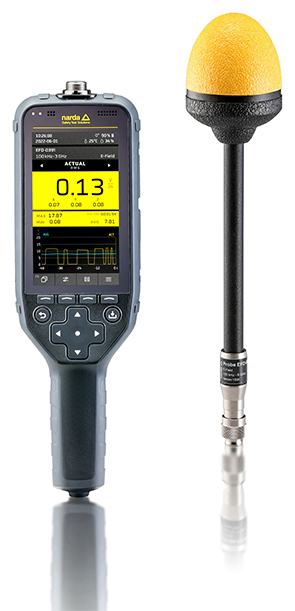
FieldMan basic unit and isotropic EFD electric field probe. Basic unit without probe: 51 × 93 × 312 mm, 695 g.
Which set and which probe do you need?
Two things determine the choice: the frequency of the source and the expected field strength. First choose the probe that covers your frequency range, then the set that supports that probe. The table below is a starting point for the most common situations; for a definite selection, tell us which sources you will be measuring.
| What you will measure | Recommended set | Recommended probe | Why |
|---|---|---|---|
| Base stations, Wi-Fi, sub-6 GHz 5G; environmental measurements under telecom regulations | FieldMan RF Basic Set | EFD-0391 (up to 3 GHz) or EFD-0691 (up to 6 GHz) | Lower limit from 0.2 V/m also shows environmental levels far below the limit value |
| Mobile communications and WLAN contribution only (excluding FM/TV broadcasting) | FieldMan RF Basic Set | EFD-0692 | Suppresses broadcast signals below 600 MHz |
| FM/TV broadcast transmitters, close to high-power transmitters | FieldMan RF Basic Set | EFD-0392 | Measures up to 1300 V/m; destruction level 2000 V/m |
| Short- and medium-wave transmitters, HF communications; near field | FieldMan RF Basic Set | HFD-3061 (H-field) + an E-field probe | Below 30 MHz, E and H must be measured separately in the near field |
| Radar, satellite earth stations, microwave links (18–40 GHz) | FieldMan RF Basic Set | EFD-1891, EFD-4091 | Continuous coverage from 2 MHz to 18 or 40 GHz |
| Pulsed radar, multi-signal environments, true RMS value | FieldMan RF Basic Set | EFD-5091 (thermocouple) | A thermocouple sensor measures true RMS by its nature; peak destruction level 20 kV/m |
| Millimetre wave: 5G FR2, 60 GHz links, automotive radar, up to 90 GHz | FieldMan RF Basic Set | EFD-6091, EFD-9091 | From 100 MHz to 60 or 90 GHz |
| Sites with several frequencies; result directly as “percent of the limit” | FieldMan RF Basic Set | EDD-5091 (ICNIRP 2020) or other ExD-5091 probes | Frequency response is shaped to the standard; the display reads in % |
| Power lines, transformers, switchyards (50 Hz and harmonics) | FieldMan LF Basic Set | EHP-50F | Both electric and magnetic field; frequency-selective measurement by FFT |
| Induction furnaces, welding machines, industrial plants, rail systems, electric vehicles | FieldMan BFD-400 Set | BFD-400-1 (included in the set) | 1 Hz – 400 kHz; weighted peak method |
| Very close to small sources, equipment surfaces, confined spaces | FieldMan LF Basic Set or BFD-400 Set | BFD-400-3 | 3 cm² sensor; resolves the local field |
| MRI scanners, permanent magnets, DC systems, electrolysis | FieldMan LF Basic Set | HP-01 | Starts at 0 Hz; static fields up to ±10 T |
| Both low frequency and RF | FieldMan Basic Set | LF and RF probes as required | Comes with the LF and RF options and the data storage option |
| High field strengths, EMC chambers, places where the operator must stay away from the measurement point | Any RF set | Probe + Digital Broadband Probe Repeater | The probe is placed up to 50 m away over a fibre-optic cable |
| You already own NBM-500 series probes | Any RF set | Existing NBM probe + A/D Probe Converter | All NBM probes can be used with FieldMan |
FieldMan basic unit: key features
The basic unit houses the display, processor, memory, battery and interfaces. Measurement frequency and level range depend on the probe attached. The values below are taken from NARDA’s FieldMan datasheet.
Digital probe interface
No calibration of the basic unit
Probes transmit measurement data digitally. Compared with analogue, high-impedance interfaces, interference is markedly reduced. The probe is recognised automatically; temperature compensation and automatic offset correction mean the measurement is not interrupted for zeroing. The self-test function detects sensor faults, so no separate check with a test generator is needed.
5-inch HD display
1280 × 720, readable in sunlight
Anti-reflective colour TFT display; brightness is set manually or automatically by a light sensor. Actual, maximum, minimum, average and maximum-average values, the time graph, the spectrum and the limit line are shown on the same screen. The user interface is largely icon-based; menu languages are English and German.
Environment and position data
Temperature, humidity, pressure, GPS, height above ground
Temperature (−40 … +85 °C), relative humidity (0–100%) and air pressure (300–1100 hPa) are recorded with every measurement. With the optional GPS / range finder, the 72-channel GNSS position (2.5 m CEP) and the height above ground between 0.25 and 4 m are written to the report automatically; no tape measure is needed.
Storage and documentation
Project folders, voice, text, photos
Results are saved at the press of a key or by timer; a 16 GB microSD card is supplied with the instrument (up to 128 GB supported, 750 MB internal memory). Screenshots are stored as PNG files. Text comments can be added to a measurement, and voice comments on the wireless model (2460/01); on instruments with the wireless option, photos and videos taken with the phone are transferred to the project folder via the FieldMan app.
Interfaces
USB-C, Gigabit Ethernet, optical, Wi-Fi
USB-C (USB 2.0; also used for charging), Gigabit Ethernet and an optical serial port (≥ 1 Mbit/s; EHP-50F, HP-01 and the Repeater connect here). With the optional Wi-Fi the instrument is monitored and remote-controlled from the FieldMan app on a smartphone. The Narda-TSX PC software is supplied with the set.
Built for field use
IP54, 16 hours, 5000 m altitude
Operating temperature −20 … +50 °C, protection class IP54 (probe attached, cover closed). The user-replaceable Li-Ion battery gives a nominal 16 hours of operation; it charges in 4 hours via USB-C PD (80% in 2.5 hours). The RF immunity of the basic unit is 200 V/m (100 kHz – 60 GHz); in stronger fields the Repeater is used.
Measurement modes
The modes available depend on the probe attached. “Broadband probes” means the EFD, HFD and ExD series; “selective probes” means BFD-400-1 and BFD-400-3.
| Mode | What it does | Broadband probes | Selective probes (BFD) | EHP-50F | HP-01 |
|---|---|---|---|---|---|
| Field Strength | Actual, maximum, minimum, average, maximum average; graph over time | Yes | Yes | Yes | Yes |
| Spatial Average | Value per position for up to 100 points and the spatial average | Yes | Yes | Yes | Yes |
| Timer Logging | Long-term logging with automatic switch-on and switch-off; start delay up to 24 hours, duration up to 100 hours, logging interval 1 s – 6 min | Yes | Yes | Yes | Yes |
| Spectrum | Frequency spectrum with selectable limit line | Yes | — | Yes | Yes |
| Shaped Time Domain | Weighted peak / weighted RMS (WPM / WRM); result as a percentage of the limit value | — | Yes | Yes | — |
| Scope | Signal recording in the time domain, 25% pre-trigger, 1 ms – 30 s | — | — | Yes | Yes |
Averaging times: 1 s, 3 s, 10 s, 30 s, 1 min, 3 min, 6 min, 10 min, 30 min, 1 h, 6 h, 24 h. Source: NARDA FieldMan datasheet. The modes supported by each probe are also stated in its own datasheet.
FieldMan technical specifications
| Specification | Value |
|---|---|
| Frequency coverage | 0 Hz (DC) – 90 GHz; depending on the probe |
| Broadband probes | 100 kHz – 90 GHz, electric and magnetic field |
| Selective probes | 1 Hz – 400 kHz, magnetic field (B) |
| Units | Electric field: V/m, mW/cm², W/m², % of standard · Magnetic field: A/m, Tesla, Gauss, mW/cm², W/m², % of standard |
| Display | 5-inch colour TFT, 1280 × 720, anti-reflective, readable in sunlight |
| Memory | Removable microSD (up to 128 GB; 16 GB card included) or 750 MB internal memory |
| Interfaces | Digital probe interface, optical port (≥ 1 Mbit/s), USB-C (USB 2.0), Gigabit Ethernet, Wi-Fi (option; 2460/01 only) |
| Position (option) | 72-channel GNSS receiver, 2.5 m CEP |
| Range finder (option) | 0.25 m – 4 m |
| Battery | Internal Li-Ion, user-replaceable; nominal 16 hours |
| Charging | USB-C PD (max. 12 V / 3 A); nominal 4 hours, 80% in 2.5 hours |
| RF immunity | 200 V/m (100 kHz – 60 GHz) |
| Static magnetic field immunity | ≤ 30 mT |
| Operating temperature | −20 °C … +50 °C (0 … 40 °C while charging) |
| Humidity | < 29 g/m³ (< 93% RH at +30 °C), non-condensing |
| Protection class | IP54 (probe attached, cover closed, stand folded) |
| Operating altitude | Up to 5000 m; suitable for outdoor use |
| Dimensions and weight | 51 × 93 × 312 mm, 695 g (without probe) |
| Conformity | 2014/53/EU (RED), or 2014/30/EU for the radio-free model; EN 61326-1:2021; IEC/EN 61010-1; RoHS 2011/65/EU |
| Country of origin | Germany |
The instrument and the selected probes evaluate against the ICNIRP, 2013/35/EU (EU EMF Directive), IEEE C95.1 and FCC limit values. FieldMan datasheet (PDF)
FieldMan sets and ordering numbers
FieldMan is sold in sets configured by application. Every set contains the basic unit, hard case, USB-C power supply, 2 m USB-C cable, shoulder strap, probe marking rings, quick start guide and the Narda-TSX software. Except for the BFD-400 Set, probes are not included in the sets and are selected separately. Each set is also available in a “radio-free” version without Wi-Fi, preferred for facilities and laboratories where wireless-transmitting devices are not allowed.
| Set | Contents and intended use | Ordering no. | Radio-free version |
|---|---|---|---|
| FieldMan Basic Set | RF + LF options and the data storage option. Fully equipped for users who measure both low frequency and RF. | 2460/101 | 2460/201 |
| FieldMan RF Basic Set | RF option; supports all RF probes up to 90 GHz. The cost-effective successor to the NBM-520. | 2460/112 | 2460/212 |
| FieldMan LF Basic Set | LF option; DC – 400 kHz. Supports the BFD-400-1, BFD-400-3, EHP-50 and HP-01 probes in all their modes. | 2460/114 | 2460/214 |
| FieldMan BFD-400 Set | LF option + BFD-400-1 probe (100 cm²). The cost-effective successor to the ELT-400; 1 Hz – 400 kHz. | 2460/113 | 2460/213 |
Options and later upgrades
Sets can be upgraded later; you can start with RF and add LF, or the other way round.
| Option | Description | Ordering no. |
|---|---|---|
| GPS / Range Finder | GNSS position and height-above-ground measurement | 2460/95.11 |
| Wireless | Wi-Fi; only for wireless-capable instruments (2460/01, e.g. Set 2460/101) | 2460/95.12 |
| FieldMan RF | RF upgrade for the LF Basic Set and BFD-400 Set | 2460/95.13 |
| FieldMan LF | LF upgrade for the RF Basic Set | 2460/95.14 |
| Data Storage | Data storage upgrade for the LF Basic Set and RF Basic Set | 2460/95.15 |
| Narda-TSX Live Measurement | Operate FieldMan digital probes directly from a PC | 2460/95.01 |
FieldMan probes
All FieldMan probes are isotropic: they measure in three mutually perpendicular axes and give a direction-independent result; you do not need to point the probe at the source. The probes fall into four groups: flat-response electric field probes (EFD), electric field probes shaped to a standard (ExD), high-frequency magnetic field probes (HFD), and low-frequency probes and field analyzers (BFD, EHP, HP). The recommended calibration interval for every probe is 24 months.
EFD series
Electric field, 100 kHz – 90 GHz, flat frequency response
General-purpose E-field probes. The result is given in V/m or as power density. Ten models with upper limits of 3, 6, 8, 18, 40, 50, 60 and 90 GHz. EFD-5091 uses a thermocouple sensor, the others diode sensors. 308 mm × Ø 66 mm, under 100 g.
ExD-5091 series
Shaped (standard-weighted) electric field, up to 50 GHz
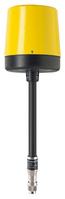
The frequency response is shaped to the limit curve of a specific standard; the display reads directly in “percent of standard”. Four models for FCC 1997, IEEE C95.1-2019, Safety Code 6 (2015) and ICNIRP 2020. Diode and thermocouple sensors are combined.
BFD-400-1
Magnetic field (B), 1 Hz – 400 kHz, 100 cm²
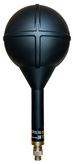
Selective probe with the 100 cm² sensor area called for by the standards. Measurement ranges of 80 µT, 800 µT, 8 mT and 80 mT; RMS and peak detectors. With the weighted peak (WPM) and weighted RMS (WRM) methods it gives the result as a percentage of the limit value.

BFD-400-3
Magnetic field (B), 1 Hz – 400 kHz, 3 cm²
The small sensor area resolves fields very close to the source and fields that change rapidly in space: welding guns, induction coils, shop anti-theft (EAS) antennas, vehicle interiors. Real-time FFT (1024 / 2048 / 4096 points) and scope mode. Ø 33 mm × 246 mm, 100 g.
EHP-50F
Electric and magnetic field analyzer, 1 Hz – 400 kHz
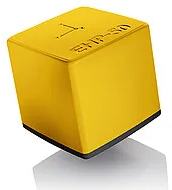
E and B field in one housing; frequency-selective measurement with a 1024-point FFT and the weighted peak method in the time domain. E-field 5 mV/m – 100 kV/m, B-field 0.3 nT – 10 mT. Connects to FieldMan over a fibre-optic cable; also works with a computer or stand-alone.
HP-01
Magnetometer, DC (0 Hz) – 1 kHz
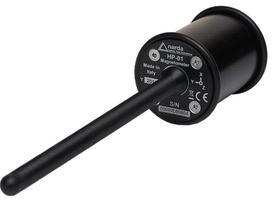
Temperature-compensated three-axis Hall sensor. Static and low-frequency magnetic fields from ±10 µT to ±10 T; 120 dB dynamic range. FFT spectrum, time domain, spectrogram. For MRI facilities, permanent magnet production, DC systems and electrolysis.
Electric field (E) probes — flat frequency response
The “CW” column gives the measurement range for a single-carrier continuous signal; the “True RMS” column gives the range in which the probe correctly measures the true RMS value of multiple or modulated signals. For diode-sensor probes the true RMS range is narrower than the CW range; above it the probe may over-read in multi-signal environments. For the thermocouple-sensor EFD-5091 the entire range is true RMS.
| Probe | Frequency | Measurement range (CW) | True RMS range | CW destruction level | Dynamic range | Ordering no. | Datasheet |
|---|---|---|---|---|---|---|---|
| EFD-0391 | 100 kHz – 3 GHz | 0.2 – 320 V/m | 0.2 – 10 V/m | 800 V/m | 64 dB | 2462/01B | |
| EFD-0392 (high power) | 100 kHz – 3 GHz | 0.5 – 1300 V/m | 0.5 – 36 V/m | 2000 V/m | 68 dB | 2462/12B | |
| EFD-0691 | 100 kHz – 6 GHz | 0.2 – 650 V/m | 0.2 – 17 V/m | 1000 V/m | 70 dB | 2462/14B | |
| EFD-0692 | 600 MHz – 6 GHz | 0.2 – 650 V/m | 0.2 – 17 V/m | 1000 V/m | 70 dB | 2462/20B | |
| EFD-0891 | 100 kHz – 8 GHz | 0.55 – 900 V/m | 0.55 – 17 V/m | 1500 V/m | 64.3 dB | 2462/24B | |
| EFD-1891 | 2 MHz – 18 GHz | 0.6 – 800 V/m | 0.6 – 65 V/m (typical) | 1100 V/m | 62.5 dB | 2462/02 | |
| EFD-1891 Fast Response | 2 MHz – 18 GHz | 0.6 – 800 V/m | 0.6 – 65 V/m (typical) | 1100 V/m | 62.5 dB | 2462/23 | |
| EFD-4091 | 2 MHz – 40 GHz | 1.2 – 800 V/m | 1.2 – 65 V/m | 1500 V/m | 56.5 dB | 2462/19 | |
| EFD-5091 (thermocouple) | 300 MHz – 50 GHz | — | 8 – 614 V/m | 1350 V/m (peak: 20 kV/m) | 37 dB | 2462/03B | |
| EFD-6091 | 100 MHz – 60 GHz | 0.5 – 400 V/m | 0.5 – 61.4 V/m | 1600 V/m | 58 dB | 2462/17 | |
| EFD-9091 | 100 MHz – 90 GHz | 0.5 – 400 V/m | 0.5 – 61.4 V/m (typical) | 1600 V/m | 58 dB | 2462/18 |
EFD-0692 suppresses broadcast signals below 600 MHz and so measures only the contribution of mobile communications and wireless networks. The applications of EFD-0891 include UWB and radar sensors. Values are taken from the NARDA datasheets; for linearity, frequency response and isotropy tolerances see the relevant datasheet.
Shaped (standard-weighted) electric field probes
Limit values vary with frequency. If a site has several transmitters, you cannot compare the total V/m reading of a flat-response probe with a single limit; you would need to know how much each frequency contributes. A shaped probe performs this weighting in hardware and displays the total exposure directly as a percentage of the standard . The measurement range of the four models is 0.8% to 600% of the standard and the CW destruction level is 2000% of the standard; 350 mm × Ø 104 mm, 250 g.
| Probe | Shaped to | Frequency | Ordering no. |
|---|---|---|---|
| EAD-5091 | FCC 1997 — occupational / controlled environment | 300 kHz – 50 GHz | 2462/07 |
| EBD-5091 | IEEE C95.1-2019 — restricted environment | 3 MHz – 50 GHz | 2462/21 |
| ECD-5091 | Safety Code 6 (2015), Canada — controlled environment | 300 kHz – 50 GHz | 2462/16 |
| EDD-5091 | ICNIRP 2020 — occupational exposure | 1 MHz – 50 GHz | 2462/22 |
ExD-5091 shaped probes datasheet (PDF). For applications in Turkey and the EU, the EDD-5091 shaped to ICNIRP is the first model to consider; let us verify together, before you order, that it matches the regulation your measurement is based on.
Magnetic field (H) probes — high frequency
In the far field, the electric and magnetic fields are linked by a fixed ratio, so measuring one is enough. Close to the source (near field) this ratio no longer holds and the two fields must be measured separately. For transmitters below 30 MHz, where wavelengths are long, and at industrial RF heating, welding and drying plants, the measurement point is usually in the near field.
| Probe | Frequency | Measurement range (CW) | True RMS range | CW destruction level | Dynamic range | Dimensions | Ordering no. | Datasheet |
|---|---|---|---|---|---|---|---|---|
| HFD-3061 | 300 kHz – 30 MHz | 0.012 – 16 A/m | 0.012 – 0.7 A/m | 35 A/m | 62 dB | 292 mm × Ø 127 mm, < 250 g | 2462/05 | |
| HFD-0191 | 27 MHz – 1 GHz | 0.016 – 16 A/m | 0.016 – 1 A/m | 20 A/m | 60 dB | 308 mm × Ø 66 mm, < 100 g | 2462/06 |
HFD-3061: short- and medium-wave transmitters, HF communication services and industrial plants. HFD-0191: radio and TV broadcasting, communications and high-frequency industrial applications.
Low-frequency probes and field analyzers
| Product | Field type | Frequency | Measurement range | Highlights | Ordering no. | Datasheet |
|---|---|---|---|---|---|---|
| BFD-400-1 | Magnetic (B), 100 cm² | 1 Hz – 400 kHz | Ranges: 80 µT, 800 µT, 8 mT, 80 mT | WPM / WRM; destruction level 300 mT at 50 Hz; uncertainty 3% (5 Hz – 200 kHz); 296 mm × Ø 125 mm, 240 g | 2463/01 | |
| BFD-400-3 | Magnetic (B), 3 cm² | 1 Hz – 400 kHz | Ranges: 80 µT, 800 µT, 8 mT, 80 mT | WPM (IEC/EN 62311), WRM (IEC/EN 62233), FFT, scope; destruction level 1500 mT; uncertainty 5% | 2463/02 | |
| EHP-50F | Electric (E) and magnetic (B) | 1 Hz – 400 kHz | E: 5 mV/m – 100 kV/m · B: 0.3 nT – 10 mT | 1024-point FFT, 8 spans from 100 Hz to 400 kHz; weighted peak; 92 × 92 × 109 mm, 550 g | 2404/105 (for FieldMan, without case) · 2404/104 (stand-alone / PC) | |
| HP-01 | Magnetic (B), including static | 0 Hz – 1 kHz | ±10 µT – ±60 mT and ±0.010 T – ±10 T | Three-axis Hall sensor, 120 dB dynamic range, 6 h battery life | 2405/101 |
Limit values stored in the BFD probes: 2013/35/EU, ICNIRP 1998, ICNIRP 2010, EMFV 2016, GB 8702, TREMF, IEEE C95. The EHP-50F datasheet additionally lists ICNIRP 2020, IEEE C95.1-2019 and IEEE C95.6-2002. Copy of the EHP-50F datasheet on our site: Datasheet_EHP50F.pdf.
Repeater, converter and software
Three products extend what FieldMan can do: the Digital Broadband Probe Repeater, which moves the probe tens of metres away from the instrument; the A/D Probe Converter , which connects older NBM probes to FieldMan; and the Narda-TSX Live Measurement option, which runs the probe directly from a computer.
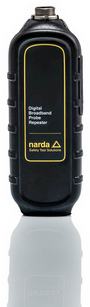
Digital Broadband Probe Repeater
Ordering no. 2464/01 · moves the probe up to 50 m away
Converts the probe’s digital electrical signal into an optical signal and carries it to FieldMan over a fibre-optic cable. Because fibre is non-conductive the cable does not disturb the field, and the operator stays away from the measurement point.
- Fibre lengths: 2, 5, 10, 20 and 50 m
- RF immunity: typically 1000 V/m (100 kHz – 60 GHz)
- Battery: nominal 130 hours; charges via USB-C in under 5 hours
- IP54, −20 … +50 °C
- 153 × 55 × 41 mm, 240 g
- No calibration required; supplied with a test report
Works directly with all FieldMan RF broadband probes, and with NBM probes via the A/D Probe Converter. Datasheet (PDF)
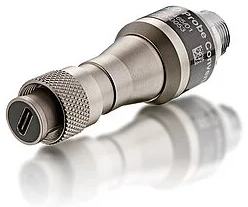
A/D Probe Converter
Ordering no. 2465/01 · use NBM probes on FieldMan
Fitted between an analogue NBM probe and FieldMan; it digitises the probe signal. According to NARDA there is no probe restriction: all existing NBM probes can be used. Organisations moving from the NBM-500 series to FieldMan protect their investment in probes.
- Compatibility: FieldMan 2460/01, Repeater 2464/01, all NBM probes
- Automatic offset correction: −20 … +50 °C
- RF immunity: 1000 V/m (100 kHz – 60 GHz)
- IP54 (probe attached)
- 82 mm × Ø 25 mm, 100 g; powered from FieldMan
- Supplied with a calibration certificate; recommended interval 24 months
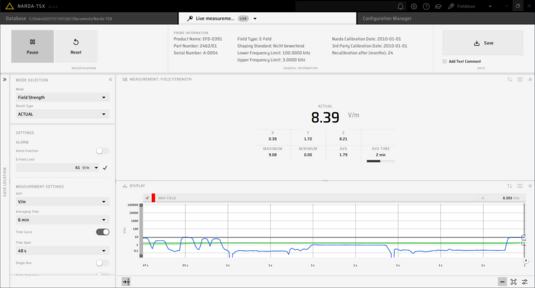
Narda-TSX and Live Measurement
Ordering no. 2460/95.01 · run the probe from a PC
Narda-TSX is the PC software supplied with the set for instrument configuration, evaluation of measurement data and reporting. The Live Measurement option adds FieldMan’s measurement functions to the software: you can connect an RF probe directly to the computer and measure without the basic unit (analogue NBM probes need the A/D Probe Converter). The basic unit can also be remote-controlled.
Narda MultiProbePilot software runs several probes at the same time; measurement data is delivered in real time and can be passed to your own software or automated test set-up through the SCPI interface. It is suited to EMC chamber and production-line testing.
FieldMan App (on instruments with the wireless option) shows the measurement live on the phone, adds photos and prints to a compatible printer.
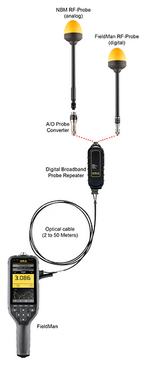
Repeater connection: probe (or A/D Probe Converter + NBM probe) → Repeater → fibre-optic cable → FieldMan.
When is the Repeater needed?
The RF immunity of the FieldMan basic unit is 200 V/m. In fields above that the instrument’s electronics may be affected, and standing in a field of that level is not appropriate for the operator either. The Repeater’s immunity is typically 1000 V/m, and it is the only electronic part that stays at the measurement point together with the probe.
- Around high-power transmitters and radar — the operator stays at a safe distance
- EMC immunity tests — verification of the field level in anechoic chambers and TEM / GTEM cells; the fibre is routed out through the chamber’s waveguide feed-through
- Reducing operator influence — the human body disturbs the field; repeatability improves when the probe stands alone on a tripod
- Hard-to-reach points — masts, roof edges, inside machinery
The Repeater can also be connected directly to a computer without FieldMan, using the optical-to-USB converter (2260/90.07) and the Live Measurement option.
Accessories and ordering numbers
| Accessory | Description | Ordering no. |
|---|---|---|
| Digital Broadband Probe Repeater | Fibre-optic probe extender | 2464/01 |
| A/D Probe Converter | Converter for NBM probes | 2465/01 |
| Tripod, non-conductive | 1.65 m, with carrying bag | 2244/90.31 |
| Tripod extension | 0.50 m, non-conductive (for 2244/90.31) | 2244/90.45 |
| Tabletop tripod | 0.16 m, non-conductive | 2244/90.32 |
| Handle | 0.42 m, non-conductive | 2250/92.02 |
| Digital probe extension cable | 2 m | 2460/90.02 |
| Digital probe to USB 2.0 (type A) cable | 3 m / 5 m; for connecting the probe to a PC | 2460/90.03 / 2460/90.08 |
| Fibre-optic cable, duplex, RP-02 | 2 m / 5 m / 10 m / 20 m / 50 m | 2260/91.02 / .09 / .07 / .03 / .04 |
| Fibre-optic cable, F-SMA – RP-02 | 0.3 m | 2260/91.01 |
| Optical-to-USB converter | RP-02 / USB | 2260/90.07 |
| Optical-to-RS232 converter | RP-02 / DB9 | 2260/90.06 |
| USB 2.0 – RS232 adapter cable | 0.8 m | 2260/90.53 |
| Spare battery | Rechargeable Li-Ion | 2460/90.07 |
| Power supply | USB-C | 2259/92.29 |
| Car charger adapter | USB-C PD | 2259/92.28 |
| Probe marking rings | For FieldMan probes | 2460/90.04 |
A non-conductive tripod and handle prevent metal parts from disturbing the field during measurement; recommended for measurements that go into a report.
Electromagnetic field measurement: a short guide
Six concepts are enough to choose the right probe and interpret the result correctly.
Broadband or frequency-selective?
Broadband measurement gives the sum of all sources within the probe’s frequency range as a single figure; it is fast and answers the question “is the limit exceeded”. It does not tell you how much each transmitter contributes. When contributions have to be separated, a frequency-selective measurement is made. FieldMan shows a spectrum at low frequency (BFD, EHP-50F, HP-01); at RF it measures broadband.
Electric field or magnetic field?
Far enough from the source (far field), E and H are linked by a fixed ratio; an E-field probe is sufficient and power density is calculated from it. In the near field this relationship does not hold and the two are measured separately. At low frequency (50 Hz, induction, welding) the magnetic field is usually the determining quantity.
Diode or thermocouple?
A diode sensor is sensitive and offers a wide dynamic range (70 dB for EFD-0691); it suits low environmental levels. In multi-signal or pulsed environments, however, it may over-read at high levels. A thermocouple sensor works thermally, measures true RMS by its nature and withstands pulse peak power; in return its lower limit is high (8 V/m for EFD-5091).
Flat response or shaped?
A flat response probe weights every frequency equally; the result is in V/m and is compared directly with the limit when there is one dominant source. Shaped probe weights each frequency by the limit value at that frequency; the result is a percentage and remains valid when there are several sources.
Time and spatial averaging
Exposure limits are defined on averaged, not instantaneous, values; in ICNIRP 1998 the averaging time for RF is 6 minutes. The field also varies over the height of the human body, so it is measured at several heights and spatially averaged. FieldMan itself calculates averaging times from 1 second to 24 hours and spatial averages over up to 100 points.
Weighted peak
At low frequency, signals are mostly non-sinusoidal: welding machines produce pulses, drives produce harmonics. The weighted peak method filters the signal in the time domain with the inverse of the limit curve and gives the result as a single percentage. The BFD probes and EHP-50F support this method.
Example: ICNIRP 1998 reference levels
The values below are the electric field reference levels for the general public given in the ICNIRP 1998 guidelines; they are shown as an example for judging the measurement range when choosing a probe. The limit values that apply to you are those of the regulation in force in your country and, for workplaces, the relevant occupational health and safety legislation; national limits may differ from the ICNIRP values.
| Frequency | General public, E-field reference level (ICNIRP 1998) | Example of a suitable probe |
|---|---|---|
| 900 MHz | ≈ 41 V/m | EFD-0391, EFD-0691 |
| 1800 MHz | ≈ 58 V/m | EFD-0391, EFD-0691 |
| 2 GHz – 300 GHz | 61 V/m | EFD-0691 (up to 6 GHz); above that EFD-1891 … EFD-9091 |
The 0.2 V/m lower limit of EFD-0391 and EFD-0691 is below one percent of these levels; the measurement range is also sufficient for verifying per-device limits defined as a small fraction of the limit value.
Common measurement situations and what to do
| Situation | Likely cause | What to do |
|---|---|---|
| The reading is much lower than expected | The source frequency is outside the probe’s range (e.g. EFD-0391 for 3.5 GHz 5G) | Use a probe that covers the source frequency; EFD-0691 measures up to 6 GHz |
| The value is close to the probe’s lower limit and unstable | The level is below the probe’s measurement range (e.g. below 8 V/m with EFD-5091) | Choose a more sensitive diode-sensor probe |
| The value at a multi-transmitter site is higher than expected | A diode-sensor probe is working above its true RMS range | Check the true RMS range in the datasheet; if necessary use a thermocouple (EFD-5091) or shaped probe |
| The average near a radar is low, yet there is a risk | With pulsed signals the peak power is far above the average | Watch the probe’s peak destruction level; use a thermocouple probe |
| Repeated measurements at the same point do not agree | The operator’s body, a metal tripod or nearby objects are disturbing the field | Use a non-conductive tripod; move the probe away with the Repeater |
| The result is in V/m but there are several frequencies; how is it compared with the limit? | A flat-response probe applies no frequency weighting | Use a shaped probe (ExD-5091) or make a frequency-selective measurement |
| The E-field near a transmitter is low, but doubts remain | In the near field the magnetic field may dominate | Measure the magnetic field separately with HFD-3061 / HFD-0191 |
| The RMS value at a welding machine or induction furnace is below the limit | RMS is misleading for non-sinusoidal signals | Measure with a BFD probe in weighted peak (Shaped Time Domain) mode |
| The measurement point is above 200 V/m | The RF immunity of the basic unit is exceeded | Use the Repeater; choose a probe with a suitable measurement range (e.g. EFD-0392) |
| The probe has gone for calibration and measurements have stopped | — | The basic unit needs no calibration; continue measuring with a second probe |
Frequently asked questions
What is an EMR meter and what does FieldMan measure?
An EMR meter is an instrument that measures the strength of the electromagnetic field at a location. Depending on the probe attached, NARDA FieldMan measures electric field (V/m), magnetic field (A/m, Tesla) and power density (W/m², mW/cm²) from 0 Hz to 90 GHz, and also shows the result as a percentage of the limit value of the selected standard.
What is the difference between FieldMan and NBM-550 / NBM-520?
FieldMan is the successor to the NBM-500 series. The main differences: digital probe interface (no calibration of the basic unit), 5-inch HD display, temperature, humidity and pressure sensors, optional GPS and range finder, Gigabit Ethernet and USB-C, Wi-Fi with a phone app, and spectrum and scope modes at low frequency. Your NBM probes can be used on FieldMan with the A/D Probe Converter.
Does the basic unit really not need calibration?
According to NARDA it does not: the part of the measurement chain that is subject to calibration is inside the probe, and the probe transmits its data digitally. It is the probes that are calibrated; the recommended interval is 24 months. Probes are supplied with accredited (DAkkS, ILAC-MRA) calibration. If your organisation’s quality system or accreditation scope requires a separate verification of the basic unit, let us clarify this together before you order.
Which set and probe are needed for base station measurements?
The FieldMan RF Basic Set with the EFD-0691, which covers all mobile communication bands up to 6 GHz, is the most common combination; if you will only measure up to 3 GHz, the EFD-0391 is sufficient. We recommend the GPS / Range Finder option so that position and height above ground are written to the report automatically.
Can 5G be measured?
5G bands below 6 GHz are measured with EFD-0691 or EFD-0891, millimetre-wave bands with EFD-4091, EFD-6091 or EFD-9091. At RF, FieldMan measures broadband; if code-selective decoding of the 5G signal and extrapolation to maximum traffic are required, a frequency-selective instrument is needed.
What should be considered when measuring radar?
With pulsed radar the peak power is far above the average. The thermocouple-sensor EFD-5091 measures the true RMS value and has a peak destruction level of 20 kV/m. With rotating antennas, the averaging time and the max-hold function are used together. In strong fields, move the probe away with the Repeater.
What do you recommend for 50 Hz power lines and transformers?
If both electric and magnetic field are required, EHP-50F; if only magnetic field with weighted peak evaluation is required, the BFD-400 Set. Both cover 1 Hz – 400 kHz and show the harmonics.
Who is the “radio-free” version for?
It is the version without a Wi-Fi module (basic unit 2460/02). It suits defence facilities, laboratories and sensitive areas where wireless-transmitting devices are not accepted. Features that depend on Wi-Fi (phone app, photo and video transfer) and voice comments are not available on this version.
Which languages does the instrument support?
The user interface is largely icon-based; according to the datasheet the menu languages are English and German. We provide support for set-up and operation.
Is it suitable for regulatory (BTK) measurements in Turkey?
FieldMan with the EFD-0391 and EFD-0691 probes is a combination used for electromagnetic field measurements under Turkish telecom (BTK) regulations. Because the instrument and calibration requirements for a measurement authorisation certificate can change, we recommend confirming the current requirements with BTK before you apply and settling the instrument configuration together with us.
What are the delivery time and price?
Price and delivery time depend on the set, probes and options. Tell us which sources you will measure and we will send the suitable configuration and a quotation.
Why PROTEL?
| Topic | How |
|---|---|
| Distributorship | General distributor of NARDA Safety Test Solutions for Turkey |
| Product selection | We work out the set, probe and accessory combination with you, based on the sources you will measure |
| Scope | Besides FieldMan, NARDA’s other broadband and frequency-selective measuring instruments |
| Language | Product information, quotations and technical communication in Turkish and English |
| Calibration, service, training | For your requests, see our engineering, service, calibration and training page or write to us |
| Sales territory | Turkey, for NARDA products |
Get a quote for NARDA FieldMan
So that we can quickly recommend the right configuration, please tell us:
- What you will measure — base station, broadcast transmitter, radar, power line, induction, welding, MRI…
- Frequency range — the lowest and highest frequency you know of
- Expected field strength — low environmental levels or high levels close to a transmitter
- Which regulation or standard the evaluation will be based on
- NBM probes you already own , if any; which models
- Radio-free version — is it required
- GPS / range finder, Repeater, tripod and other options and accessories
- Quantity; is training required
E-mail: [email protected] · Phone: (212) 221 80 60 · WhatsApp: (532) 265 91 99
Documents
Manufacturer’s documents (in English):
- FieldMan system brochure
- FieldMan datasheet
- E-field probes: EFD-0391 · EFD-0392 · EFD-0691 · EFD-0692 · EFD-0891 · EFD-1891 · EFD-4091 · EFD-5091 · EFD-6091 · EFD-9091 · ExD-5091 shaped
- H-field probes: HFD-3061 · HFD-0191
- Low frequency: BFD-400-1 · BFD-400-3 · EHP-50F · HP-01
- Accessories: Digital Broadband Probe Repeater · A/D Probe Converter
Related pages
- NARDA EMF monitors: personal RF monitors and 24/7 area monitors
- NARDA electromagnetic field (EMR) measurement instruments
- Radio monitoring and localization (SignalShark)
- Engineering, service, calibration, training
- NARDA products
The product images and technical information on this page are © Narda Safety Test Solutions GmbH and are used with the manufacturer’s permission. Technical values are taken from the manufacturer’s datasheets; the current datasheet is binding. Source: narda-sts.com