

PROMAX cable TV analyzers
Cable TV Analyzers
Field instruments for CATV, QAM, DOCSIS and EuroDOCSIS 3.0 networks. On a cable plant the fault rarely shows on one channel: it builds up in band tilt, in the return path and in intermodulation. PROMAX analyzers are built for that job — rugged, long-lived, and multistandard so they work on any network in the world.
- QAM analysis
- DOCSIS / EuroDOCSIS 3.0
- Return path
- MER and BER
- Constellation
- Tilt and scan
- CSO-CTB and HUM
- MATV and MMDS
- Fiber optics (option)
Calibration, warranty and post-warranty service are run from Istanbul. We can load your channel plan into the instrument before delivery. We ship worldwide from our Turkey or Germany warehouses, whichever suits the customer.
Where is your network today?
The right instrument follows from where your network actually is, not from a product list. Cable plants move from analogue to digital QAM, and from there to DOCSIS and a fiber-deep HFC architecture. Three typical situations.
Analogue is still on air
Or a mixed plant
Analogue channels are still carried and the daily job is level and C/N checks. A fast, one-hand instrument you can also confirm by ear is enough.
Instrument: PROMAX-4
If you also carry digital channels, move up to the PROMAX-12 — the PROMAX-4 does not measure digital.
Digital QAM plant
Installation, acceptance and maintenance
The network is digital; nothing gets done without MER, BER and constellation. You need to measure the return path, set tilt, and hunt intermodulation and HUM.
Instrument: PROMAX-12
If you also want terrestrial DVB-T from the same instrument, add the OP-012-O option.
DOCSIS and fiber going deeper
HFC and FTTH migration
Fiber is moving closer to the subscriber and cable and optical measurement become the same crew’s job. You need one bag that covers both the coaxial and the optical side.
Instrument: RANGER mini
Terrestrial and satellite measurement come from the same instrument, so the crew carries one unit.
The instruments
The PROMAX cable TV family comprises three instruments plus a measurement option that extends the PROMAX-12.
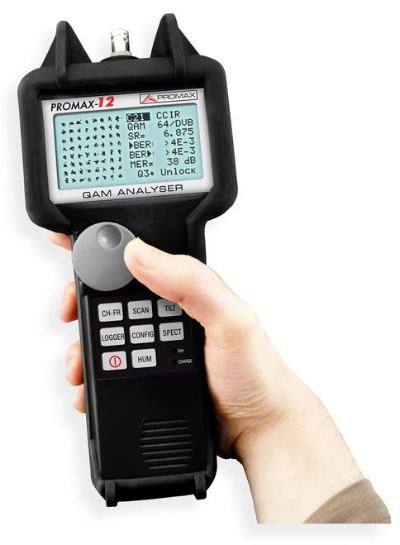
PROMAX-12
Cable TV QAM analyzer
The core instrument. Covers installation, verification and maintenance of FM radio, MATV, CATV and MMDS systems across 5–1005 MHz — including the sub-band (return path). It is multistandard, so it works on any network in the world.
Functions: level meter, logger, scan, tilt, spectrum analyser, transient detector, cable digital analyser.
Digital measurements: channel power, C/N, bit error rate (Pre-BER and Post-BER), MER, DVB-QAM constellation.
Analogue measurements: HUM, level, C/N, C/A ratio, CSO-CTB intermodulation.
Power level measurement over a complete frequency band catches saturation at the input of broadband demodulators — the measurement to reach for when you see a constellation compressed into its corners.
In the box: mains adapter and cable, soft carrying bag, F/F connector adapter, rubber shock protector. Optional: car lighter adapter, F/BNC and F/IEC adapters, hard transport case, F/F RF cable.
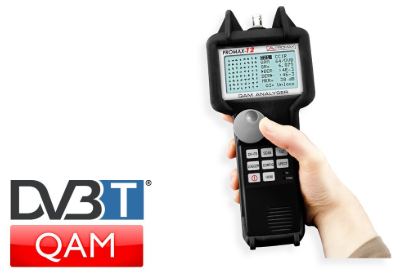
OP-012-O
DVB-T (COFDM) option for the PROMAX-12
A measurement option installed in the PROMAX-12. It displays the constellation of the carriers forming the COFDM multiplex and the related measurements — your cable analyzer also measures terrestrial digital broadcasts. You do not have to buy it up front; it can be added when the need arises.
Measurements: power, CBER, VBER, MER and C/N, shown numerically, as a level bar and as a constellation.
Power range: 35–120 dBµV.
Supported parameters: 2k and 8k carriers; guard interval 1/4, 1/8, 1/16, 1/32; code rate 1/2, 2/3, 3/4, 5/6, 7/8; constellation QPSK, 16-QAM, 64-QAM.
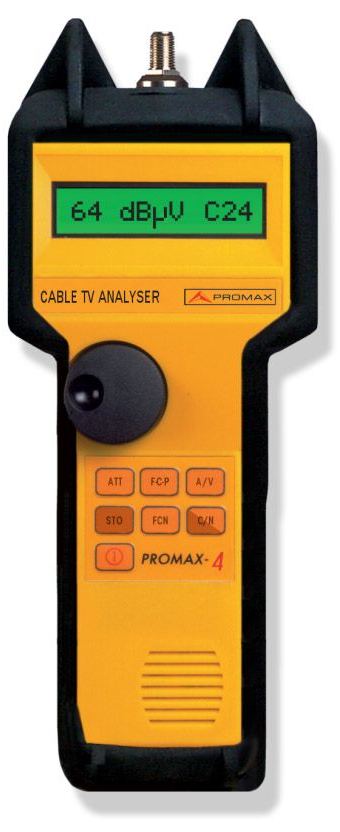
PROMAX-4
Analogue cable TV analyzer
Measures the basic parameters that determine signal quality in a CATV system, quickly and simply. Three versions are available for different needs.
One-hand operation with a direct reading on an illuminated LCD. A built-in audio demodulator and speaker lets you confirm a channel by ear. The exchangeable input connector protects the instrument — in the field it is the part that breaks first.
Tuning: 45–862 MHz, by channel, frequency or program. One channel plan, configurable from a PC.
Level: 20–120 dBµV, digital readout.
Video/audio: 0–40 dB.
C/N: 50 dB dynamic range.
Sound: AM/FM/level, internal speaker and external headphone output.
It does not make digital measurements (MER, BER, constellation). If your plant carries digital channels, look at the PROMAX-12.

RANGER mini
Cable, terrestrial, satellite and fiber in one
On the cable side it analyses DOCSIS networks; with the same instrument you also aim terrestrial antennas and satellite dishes. Pocket-sized and ruggedised.
5–2700 MHz tuning range, 230 kHz / 2 MHz resolution, dBmV / dBµV / dBm units, LNB supply 13 V / 18 V / 22 kHz. MER, preBER, postBER and constellation on one screen. Datalogger for automatic network audits.
An optional fiber optic analyzer with optical-to-RF converter covers HFC and FTTH diagnostics — as fiber moves closer to the subscriber, the same instrument keeps earning its place.
See the satellite and terrestrial capabilities on the field strength meters page
Comparison
| PROMAX-4 | PROMAX-12 | RANGER mini | |
|---|---|---|---|
| What it is | Analogue CATV level meter | Digital cable / QAM analyzer | Cable, terrestrial, satellite and fiber analyzer |
| Frequency range | 45–862 MHz | 5–1005 MHz | 5–2700 MHz |
| Return path (sub-band) | — | Yes | — |
| Level measurement | 20–120 dBµV | Yes | Yes |
| Digital measurements | — | Channel power, C/N, Pre-BER, Post-BER, MER | MER, preBER, postBER |
| Constellation | — | DVB-QAM; COFDM with OP-012-O | Yes |
| Analogue measurements | Level, video/audio, C/N | HUM, level, C/N, C/A, CSO-CTB | — |
| Spectrum analyser | — | Yes | Yes |
| Tilt and scan | — | Yes | — |
| Transient detector | — | Yes | — |
| Logger | — | Yes | Yes (datalogger) |
| DOCSIS | — | — | Yes |
| Satellite / LNB supply | — | — | Yes (13/18 V, 22 kHz) |
| Fiber optics | — | — | Optional |
| Audio speaker | Yes | — | — |
| Typical user | Field crew on an analogue or mixed plant | Digital cable installation and maintenance crew | Crews running cable, terrestrial, satellite and fiber together |
Values are the manufacturer’s published technical data. “—” means the feature is not stated for that model. We send the current datasheet with every quote.
What each measurement tells you on a cable network
On cable TV no single measurement says “good” or “bad” on its own. Read all four together and the location of the fault emerges.
MER and BER
The health of the digital signal
MER (modulation error ratio) gives you in one number how cleanly the signal is being carried. What matters is not whether it clears the threshold but its margin: a link running 2 dB above threshold will drop out on a wet day or in summer heat. Log MER regularly and you intervene before the subscriber complains.
BER is the error level before correction (Pre-BER) and after it (Post-BER). If Pre-BER has degraded but Post-BER is clean, error correction is still doing its job — your margin has shrunk but the subscriber sees nothing yet. Once Post-BER degrades, the picture is already freezing.
Constellation
The kind of impairment
Numbers tell you it is bad; the constellation tells you why. This is the measurement that locates a fault in minutes rather than hours.
- Points scattered — noise; check C/N and level
- Cloud rotated — phase noise; converter or local oscillator instability
- Corners pulled inward — compression; there is saturation at an input
- Points smeared into a line — single-frequency interference
- Cloud offset from centre — carrier leakage
Tilt and scan
The slope of the band
Coaxial cable attenuates high frequencies more than low ones, so on a long run the upper channels arrive markedly lower than the lower ones. Tilt measures that difference across the band and tells you whether amplifier gain slope is set correctly.
Scan shows the whole band on one screen. A missing channel, a collapsed channel or interference sitting in the band is obvious at a glance — it saves you walking the plan channel by channel.
Return path, CSO-CTB and HUM
Upstream and analogue impairments
The return path (5–65 MHz) is the most treacherous part of a cable plant: noise entering from every subscriber leg funnels back toward the hub (noise funneling). One loose connector or one bad in-home installation can break interactive service for a whole segment. When everything looks clean downstream but internet and VOD keep dropping, this is the first place to look.
CSO-CTB measures the intermodulation products amplifiers generate — the usual cause of streaking and ghosting on analogue channels. HUM catches 50 Hz ripple from the network supply voltage, which shows up as a band rolling through the picture.
From symptom to fault
The complaints crews meet most often, and which measurement answers them.
| Symptom | Measurement to check | Likely cause |
|---|---|---|
| Picture freezes intermittently, then recovers | MER, Post-BER | Margin is marginal. Low level or rising noise; if it tracks temperature, cable loss |
| One channel bad, neighbours clean | Channel power, MER, constellation | Channel-specific: modulator, narrowband interference, or that channel’s level |
| Upper channels weak, lower channels normal | Tilt, scan | Cable attenuation slope; amplifier gain slope mis-set or the run has grown |
| Level low across all channels | Level, scan | Wrong splitter or tap, loose or corroded connector, water ingress |
| Streaking and ghosting on analogue channels | CSO-CTB | Amplifier intermodulation — usually an overdriven amplifier |
| A band rolling through the picture | HUM | Supply voltage ripple; power supply or line powering fault |
| Internet and VOD drop, TV is fine | Return path noise (5–65 MHz) | Noise accumulating from subscriber legs; loose connector or bad in-home wiring |
| Constellation compressed into the corners | Power level over the band | Input saturation — demodulator or amplifier input being overdriven |
| Fault appears only at certain hours | Transient detector, logger | Intermittent interference; leave a log to catch its timing and level |
| Acceptance test passes but complaints continue | MER margin, return path | The link clears the threshold but has no margin left |
| Segment degraded after a new subscriber was connected | Return path noise | The new leg’s in-home wiring is injecting noise — confirm by disconnecting it |
This table summarises typical cases; every plant has its own topology and acceptance criteria.
Frequently asked questions
The questions that come up most when customers ask for a quote.
Is a cable TV analyzer the same as a satellite field strength meter?
No. Both measure RF, but they are built for different jobs. A field strength meter is about aiming antennas and dishes; a cable analyzer is about the health of a distribution plant — return path, tilt and CSO-CTB are not found on a field strength meter. If you want both, look at the RANGER mini or the RANGER Neo family.
What MER should I be seeing?
It depends on the modulation. Widely used typical thresholds are around 24 dB for 64-QAM and 30 dB for 256-QAM — below those, error correction cannot keep up.
But the number to watch is not the threshold, it is the margin: a 256-QAM link measuring 31 dB looks like a pass and has nothing in reserve. Healthy operation aims for 5–8 dB above threshold. The binding figure is always your operator’s own acceptance specification.
Why does the return path have to be measured separately?
Because downstream can be clean while upstream is broken. Noise in the return path funnels in from every subscriber leg toward the hub, so one bad in-home installation can take down internet for a whole segment. When the TV picture is fine but internet keeps dropping, this is almost always where it is. The PROMAX-12 starts its band at 5 MHz, which is what makes this measurement possible.
Can the PROMAX-12 also measure terrestrial DVB-T?
Yes, once the OP-012-O option is installed. It adds the constellation of the COFDM carriers plus power, CBER, VBER, MER and C/N. You do not have to buy the instrument with the option fitted; it can be added later.
What is a channel plan and how does it get into the instrument?
A channel plan is the frequency and modulation detail of the channels on your network. Once the instrument knows it, a technician measures by channel name instead of typing frequencies — faster in the field and no more measuring the wrong channel. The PROMAX-4 and PROMAX-12 take a channel plan from a PC. Send us yours and we load it before delivery.
Does the instrument need calibration?
Test instruments drift over time. If you run acceptance measurements and sign reports, periodic calibration is necessary — most operations do it annually. We handle calibration and periodic maintenance together with the manufacturer.
Why buy from PROTEL?
We have held the PROMAX general distributorship for Turkey since 1989. PROMAX has been building telecommunications test instruments since 1963.
| Area | How it works |
|---|---|
| Distributorship | PROMAX general distributor for Turkey since 1989 |
| Manufacturing | Spain; PROMAX has built telecommunications test instruments since 1963 |
| Delivery | Stocked items from our Istanbul or Germany warehouse; the rest to order |
| Shipping | We ship worldwide from our Turkey or Germany warehouses, whichever suits the customer |
| Channel plan | We load your network’s channel plan into the instrument before delivery |
| Calibration | We handle calibration and periodic maintenance together with the manufacturer |
| Warranty and service | Warranty and post-warranty technical service are run from Istanbul |
| Software updates | Firmware and standard updates for the life of the instrument |
| Training | Commissioning and operator training on delivery |
| Spare parts | Continuity in batteries, connector adapters and accessories |
| Counterfeits | PROMAX is a widely imitated brand. Warranted, calibrated instruments come only through the authorised distributor channel |
Request a PROMAX cable TV analyzer quote
To get a quote back quickly, tell us:
- Network type — analogue, digital QAM, DOCSIS or mixed
- Modulation — 64-QAM, 256-QAM
- Return path — whether you need to measure it
- Terrestrial, satellite or fiber — whether you expect those from the same instrument
- Your channel plan — we can load it before delivery
- How many units and how many crews they cover
- Connector type — F, BNC or IEC
- Destination country, so we can quote shipping and the right mains configuration
E-mail: [email protected] · Phone: +90 212 221 80 60 · WhatsApp: +90 532 265 91 99
Related pages
- TV and satellite field strength meters — RANGER Neo, ATLAS, alignment meters
- Fiber optic test and measurement — OTDR, optical power meters, laser sources
- PROMAX products
Product images and product technical information on this page are © PROMAX Test & Measurement, SLU and are used with the manufacturer’s permission. Source: promaxelectronics.com